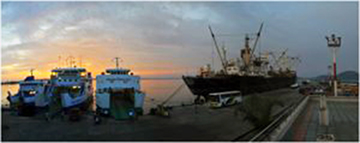
The Philippine Ports Authority (PPA) will be bidding out six ports this year under its new terminal management policy that lays down parameters for awarding port management contracts.
For bidding this year under the new Port Terminal Management Regulatory Framework (PTMRF) are the ports of Tabaco, Ormoc, Legazpi, Surigao (baseport), Puerto Princesa, and Nasipit, PPA Port Operations and Services Department manager Lilian T. Javier told PortCalls in a text message.
In a press conference on September 23, Jaview said PPA has committed to the Governance Commission for GOCCs—which oversees government-owned and controlled corporations (GOCC) such as the port authority—the bidding out of these target ports.
PPA recently held a public hearing on its proposed uniform tariff to be used as the base tariff when bidding out concessions under the PTMRF. Javier said PPA is reviewing stakeholders’ feedback on the uniform tariff, but added it aims to have uniform tariff ready once bidding for the Ormoc and Tabaco ports starts.
Embodied in PPA Administrative Order (AO) 03-2016 issued in 2016, PTMRF outlines the guidelines for awarding terminal management contracts. The framework seeks to promote private sector participation in port operations in order to provide higher quality service and reduce the agency’s administrative burden.
Under AO 03-2016, investments in ports are to be categorized into six tiers, ranging from a fully private concession to a fully PPA-managed port, to makes it easier to determine the investment arrangements of a port.
Under the new port terminal framework, concessions will be performance- or outcome-based, instead of based on the investment or the number of equipment or facilities to be provided by the concessionaire.
PPA assistant general manager for operations Hector Miole earlier explained that PTMRF is a “system where a terminal operator handles all the services in the port.”
He said this is in contrast to the current arrangement in which PPA operates the port and bids out cargo-handling operations and other ancillary services separately to different service providers.
“This time there is one accountable terminal operator, just like what you have in North Harbor, [in] MICT [Manila International Container Terminal], in South Harbor, [in] Batangas,” Miole pointed out. Currently, these ports are developed, operated, and maintained by port operators that have won concession contracts from PPA.
“We think that governance model is effective for Philippine ports,” Miole noted.
With terminal management assigned to the private sector, Mioel said PPA can then “focus on monitoring performance [and] contract provisions.”
“We’ll make sure that the users are also protected so we stand in between…we referee,” Miole added.
READ: PLSA raises concerns on PPA’s proposed uniform tariff
Asked if PTMRF will lead to lower costs, Miole said “we believe that with the integration of all the activities, the terminal operator is able to rationalize the cost and the services there.”
There should also be port efficiencies experienced with PTMRF, Miole said.
He said that PTMRF will be “focusing on deriving outputs or results of operations” and that “investments in equipment and other resources that are needed for port management will be demand driven.” He said that if there is demand, the terminal has no choice but to provide more equipment “because there are performance targets that you have to meet” under PTMRF.
He said PPA “will need to drill them [terminal operators] on that.”
He added that PTMRF also promotes ease of doing business, as port users will be dealing with only one service provider inside the port as opposed to the current practice of having to deal with several.
“Today when you go to the port, sometimes you have to transact with several parties and this creates many problems for many other users. So with one vertically integrated and laterally scaled operations, we should be able to improve on our port systems in the future,” Miole explained. – Roumina Pablo