
Philippine government agencies involved in operating the country’s international airports have been instructed to adopt a 24/7 work shift. Transportation Secretary Manuel Roxas II announced the policy recently in a letter sent to the Board of Airline Representatives and the Airline Operators Council.
 “The concerned (government agencies) agreed to adopt a policy wherein a 24/7 shifting schedule will be implemented and the government will fully finance the services rendered by these government employees in international airports,” Roxas told airline organizations in his letter. Under the new policy, the government agencies are not required to provide overtime pay for work rendered beyond the employees’ regular shifts.
The new policy addresses the concerns raised by both domestic and foreign airline operators, which, under the old policy, have had to shoulder the overtime pay of airport personnel working beyond regular office hours. The airline operators, in particular international carriers from Europe and the United States, had earlier cited this additional cost as one of the reasons why they have either stopped or reduced direct flights to and from the Philippines.
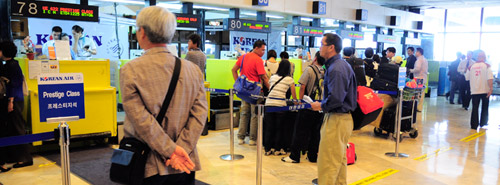
Passenger traffic at least at the NAIA is heaviest between the afternoon and midnight, and this requires the deployment of customs, immigration and quarantine (CIQ), and airport personnel during off hours.
“Government agencies performing services in international airports have been directed to field sufficient number of personnel in shifts to address their operational requirements to avoid rendering overtime,” Roxas said.
Roxas told the airline organizations to inform their members of the latest policy shift and to advice them to stop paying overtime fees to all government employees assigned to attend to their operational requirements after regular office hours.
No payment by airline companies, in cash or in kind, should now be made and violations by any of the airport-assigned personnel should be reported to his office.
Violation of the new policy, Roxas pointed out, includes work stoppage, work slow-downs or any form of action that affects the efficiency of their services.
Photo from http://125.60.203.88/miaa/index.php?option=com_content&view=article&id=83:pre-departure-security-checks&catid=53:check-in-and-security&Itemid=60