
 Smaller container shipping lines are pulling out of the east-west trades, no longer able to compete in the big-ship-dominated markets.
The recent pullout of Grand China Shipping (GCS) indicates the difficulty faced by niche market players wanting to compete against major ocean carriers in the east-west trades.
Before GCS, The Containership Company was forced to withdraw its small trans-Pacific service in April 2011, and PIL and Wan Hai had to withdraw their FES service between Asia and Northern Europe one month later as their 4,250-TEU (20-foot-equivalent unit) vessels were not competitive enough.
Horizon Lines also withdrew its Five Star Express trans-Pacific service in early November 2011. In mid-2012, MISC completely withdrew from the liner market, saying it would focus on the bulk shipping sector.
No carrier outside the top 20 lines operates ships on the Asia-North Europe route anymore, said Drewry. On the trans-Pacific, Wan Hai and Matson are the only non-top 20 carriers still operating vessels in this route. The trans-Atlantic still has four medium-sized carriers—Atlanticargo, Eimskip, ICL, and Marfret—still operating ships.
“The implication is that there is no room left for small players in the east-west trade lanes, no matter what niche market experience is brought to the table. The big players’ economies of scale are now simply too big to overcome,” Drewry continued.
The top 20 carriers have always dominated the big ship market, already controlling 100 percent of ships over 6,000 TEUs as far back as 2006, but their average vessel size has since ballooned by 43 percent, from 2,941 TEUs to 4,200 TEUs in 2012, including vessels as large as 16,000 TEUs, and Maersk Line’s twenty 18,000-TEU vessels have yet to be delivered.
To compete successfully in the Asia-North Europe trade lane, vessels over 10,000 TEUs are now required, while in the trans-Pacific, the average of all major mainline services is 6,250 TEUs. In the much smaller trans-Atlantic trade lane, the average size of vessels deployed in main line services currently reaches 4,460 TEUs.
Forecasting that the few remaining niche market services in the main east-west trades are “unlikely to survive much longer without acquiring greater economies of scale,” Drewry said small players may be better off confining themselves only to niche markets in the future.
“Shippers should start getting used to less choice, as well as the concept that big is beautiful even when seen in intra-regional services,” it added.
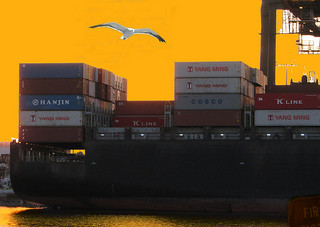
Photo: Rennett Stowe