
 The current freight rate war in the Asia-Europe and Asia-U.S. trade lanes and the further addition of new ships will force carriers to resort to more slow steaming, forecasts Drewry Maritime Research.
London-based Drewry believes ocean carriers are losing money due to the freight rate war in the east-west trades as well as to surplus capacity.
“At the end of April, there were still another 31 ships over 10,000 TEUs [20-foot-equivalent units] due for delivery this year, and carriers are running out of places to hide unwanted 8,000 TEU vessels cascaded out of the Asia-Europe trade lane,” the international shipping consultancy said.
With the slow cargo growth between Asia and the U.S. and between Asia and the South America East Coast, either more vessels will have to be laid up or further slow steaming introduced, with the latter more likely to happen, said Drewry.
For an average voyage between Asia and North Europe deploying 11 vessels running at 19k westbound and 15k eastbound, an extra vessel could be added by increasing westbound transit time by two days through a speed reduction of 1.5k, thus adding five days on the way back through a speed reduction of 2k. It would make it difficult for Maersk Line to maintain its Daily Maersk service with the same transit time guarantees, however, said Drewry.
For the trans-Pacific trade, Drewry said the calculation is more difficult due to the more variable transit times of services between north, central and southern Asia to north, central and southern WCNA (West Coast North America) ports, but due to the much shorter distances involved, the time lost would be far less.
Said Drewry: “Further vessel reductions between Asia and Europe and between Asia and the U.S., should be expected soon. It will result in longer transit times, but schedule reliability should improve due to the greater opportunity for making up lost time.”
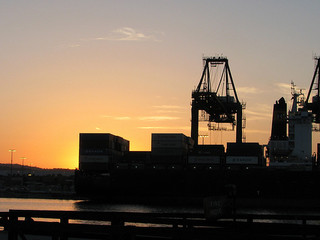
Photo: Rennett Stowe