
 Container port demand will slow down to a compound average global growth of 5.4 percent per annum through to 2017, a decrease from the 10 percent per annum estimate prior to the economic downturn, Drewry Maritime Research says in its latest forecast.
But even at this level, growth will still reach 30 percent in absolute terms over five years. This means that from a staggering 620 million 20-foot-equivalent units handled in 2012, global container ports will have to accommodate another 190 million TEUs by 2017.
“To put this into context, that is more than the entire 2012 throughput of North American, European, and Middle Eastern ports combined,” said Drewry.
The global container port industry is now so large that even with modest growth, absolute throughputs will still increase dramatically.
At port level, the numbers are even more staggering, Drewry added. Even if Singapore and Shanghai only performed at the world average of 5.4 percent per annum, it would add almost 10 million TEUs to each port’s total throughput by 2017.
“A figure of 10 million TEUs is more than the entire container port throughput of the UK, India, or Brazil,” Drewry pointed out.
Although the global volume of container cargo handled by ports fell sharply at the beginning of the economic recession at the end of 2008, it didn’t take long to recover, and currently sits at over 20 percent more than the pre-recession period in early 2008.
“All this illustrates what a colossal and sturdy industry the container port business has become—something that is often overlooked due to its wide geographic split across nearly 1,300 terminals around the world,” said Drewry.
Drewry estimates that the world’s container terminals had a turnover of around $45 billion in 2012 and, taking a mid-range profitability margin, will have generated a global EBITDA (earnings before interest, taxes, depreciation, and amortization) of over $10 billion.
However, while the industry is satisfactorily profitable, it requires continuous and substantial capital investment, said Drewry. With a ballpark investment cost of $350 million per million TEU of capacity covering both terminal infrastructure and equipment, an extra 190 million TEUs means that an investment cost of around $65 billion over the next five years will have to be found.
“Although future container volume growth will be significantly more muted than in the heydays of the 1990s and 2000s, very substantial capital investment in port/terminal capacity will still be required over the next five years,” said Drewry.
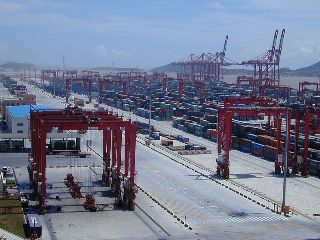
Photo: Alex Needham