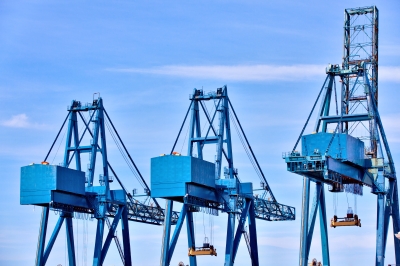
 Targeted for construction next year, Cebu’s proposed P19.3-billion international container terminal will have two 250-meter berths and four quay cranes, according to the Cebu Port Authority (CPA).
CPA, in an email to PortCalls, said plans for the Cebu International Container Terminal (CICP) Phase 1 include installing two berths that will each have two quay cranes. The facility can accommodate vessels capable of carrying 2,000 twenty-foot equivalent units (TEUs) and with a frontal depth of 12 meters.
READ: Cebu container port to begin construction Q3 2016
The terminal’s container yard will measure 53,400 square meters (sqm) while the container freight station will have an area of 11,704 sqm.
CPA noted the project cost of P19.3 billion already includes operations equipment.
The site for the new terminal is a 12-hectare piece of land in Tayud, Consolacion, northern Cebu, chosen for its ample area for expansion and lack of conflicting planned developments.
The new terminal is expected to be completed in 35 months or by the second quarter of 2019.
No firm has been selected yet to construct the port. CPA explained that in the feasibility study, the project is categorized as a third loan, which limits the source countries to the Republic of Korea and the Philippines.
The authority said “since there is a high probability that the project is implemented by an EPC (engineering, procurement, construction) type, the procurement plan may be a competitive bidding between the shortlisted Korean engineering and construction firms.”
It added that under the Economic Development Cooperation Fund procurement guidelines, the Philippine government will be responsible for the procurement of the bid assistance, construction supervision, design, and construction.
CPA said transferring the international container gateway from the existing Cebu International Port (CIP) has many advantages. It will mitigate congestion both inside and outside the port area of CIP; increase Cebu’s capacity to accommodate growing cargo traffic; propel industrial development with improved cargo-handling capacity; bring further progress not just to the whole province of Cebu but also to its neighboring links; and spur maritime trade and commerce in the region.
The CIP faced berth and yard congestion issues in 2014 through early 2015 due partly to an increase in cargo volume. After CPA took steps to decongest the terminal, yard utilization went down to around 60% in August.
In the first half of 2015, CIP handled 20.625 million metric tons (mmt) of cargo, 21.3% more than the 16.999 mmt processed in the same period last year. – Roumina Pablo
Image courtesy of Serge Bertasius at FreeDigitalPhotos.net