
 Subdued global trade growth continues to exert an impact on the airfreight industry, causing international traffic at airports worldwide to drop 2.1% in March 2016 compared to a year ago, according to Airports Council International (ACI).
Domestic freight traffic, meanwhile, increased by 9%, raising the worldwide total by 1.1% year-on-year.
For the first quarter of 2016, accumulated freight traffic showed no increase in volume compared to the previous year. International freight oscillated between a contraction of 1% and growth of 1% over the course of the year, dipping into negative territory three times within the last six months on a year-over-year basis.
Significant airfreight declines were observed in Asia-Pacific and North America in February and March.
On the individual airport level, the airfreight landscape in North America was mixed, said ACI. The major cargo hubs of Memphis and Louisville grew strong by 12% and 11.4%, respectively. But other big freight airports posted declines, such as Anchorage which slid back 3.8%, Los Angeles by 3.9%, Miami by 1.3%, Chicago-O’Hare by 13.5%, and New York by 6.7%.
In Asia-Pacific, the picture was mixed as well. While some freight hubs recorded robust growth, including Shanghai-Pudong, where traffic rose 5.7%, Singapore 5.2%, Beijing 6%, Guangzhou 14.3%, and Delhi 17.5%, several airports experienced declines. These included Seoul, where traffic fell 4%, Tokyo-Narita 10.3%, Taipei 3.5%, and Bangkok 1.4%.
This slowdown in both North America and Asia-Pacific was symptomatic with respect to increased trans-Pacific airfreight traffic a year ago, resulting from the disruptions at U.S. west coast seaports. This distortion played a role in the decline at some of the key airports in the first quarter of 2016.
In Europe, out of four major airfreight hubs, two airports reported traffic declines—Frankfurt, where volumes deflated 2%, and London-Heathrow, down 3.8%, whereas the other two—Paris and Amsterdam—showed growth of 3.6% and 0.5%, respectively, reflected in a 0.3% growth rate for the region as a whole.
While airfreight in Istanbul declined by 14.2% year-over-year, Brussels, affected by the terrorist attacks of March 22, contracted by 22.4%.
Latin America-Caribbean was the only region plunging into negative territory for March, dipping 3.8% with regard to airfreight volumes. While declines were apparent for airports in Brazil, other major airfreight hubs recorded substantial declines in airfreight as well, including Bogota, Lima, and San Juan.
The Middle East, which was outperforming all other regions in airfreight growth over the last year, showed moderation in March. The two Dubai airports were flat, and the slowdown was even more pronounced at Abu Dhabi (-5.9%). Only Doha exhibited cargo growth, rising 18.7%.
The region as a whole, however, still outperforms all other parts of the world in airfreight growth on both year-to-date and year-end bases (4.4% and 8.1%, respectively).
In Africa, the airfreight picture was uneven, too. While Casablanca and Dakar grew by 3.8% and 19.4%, respectively, Johannesburg remained flat at 0.6%, and Nairobi reported declines of 6.4%.
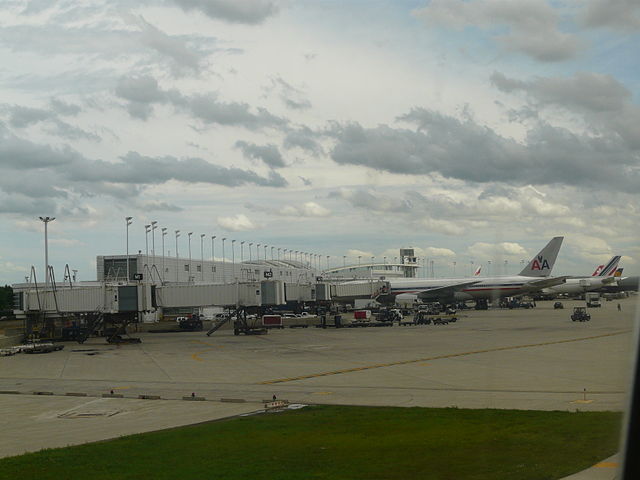
Photo: By myself (User:Piotrus)