
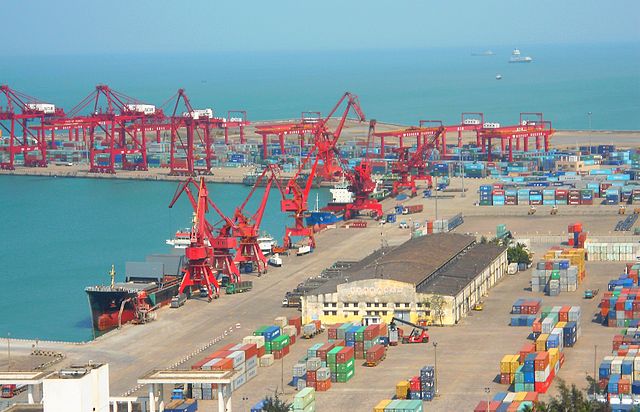
 Slower economic growth, deteriorating export competitiveness, and weak liner profitability are narrowing the headroom within the ratings of Chinese port operators, according to a new report from Moody’s Investors Service.
“Although manageable capex plans over the next three years will alleviate some of the pressure on their financial profiles, weak liner profitability will limit the port operators’ ability to raise handling charges,” said Osbert Tang, a Moody’s vice president and senior analyst.
“In addition, export-oriented ports such as Shanghai and Shenzhen will be particularly affected by slowing container throughput amid muted export growth in China,” added Tang.
Moody’s conclusions are contained in its just-released report entitled “China Ports—Slower Economic Growth Is Challenging the Sector.” The report said port operators in the country are facing major headwinds from slower economic growth and a weaker throughput outlook, which—due to the high fixed costs of port operations—could lead to margin pressure.
Overcapacity in the liner industry—the key customers of port operators—is exacerbating this pressure on the operators’ margins. Moody’s forecast that the global capacity of container ships will increase by 4.5% to 5.5% in 2016, outpacing the expected demand growth of 1.5% to 2.5%.
Consequently, shipping lines are facing significant pressure on freight rates, which in turn will make it increasingly difficult for port operators to negotiate higher container handling charges.
These pressures are somewhat mitigated by the manageable capex or capital expenditure plans for the port operators, as most have sufficient capacity to handle mega container ships. This is in contrast to many other Southeast Asian ports, which will still see relatively high capex in the next two years.
Nevertheless, Moody’s noted that headroom is narrowing in the ratings of the port operators, which it said will likely prompt them to preserve cash flow through stringent cost controls and discipline in overseas expansion.
In that context, China’s One Belt, One Road initiative will increase merger and acquisition capex for the port operators as they expand overseas, although most operators have thus far been selective in their investment decisions.
In the short term, such geographical expansion will raise the capex burden and increase political, execution, and currency risks for the operators, said the global credit rating agency.
However, in the longer term—and subject to their ability to manage these challenges–it will allow the operators to realize synergies and increase their geographical diversification, it added.
Photo: Anna Frodesiak