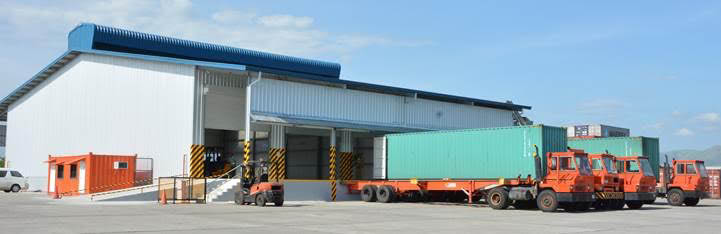


More ships are expected to call at the Port of Subic with the opening of its first container freight station (CFS) to cater to the Central Luzon market, according to the Subic Bay Metropolitan Authority (SBMA).
Port operator Subic Bay International Terminal Corporation (SBITC), in partnership with SBMA and Bureau of Customs Subic (BOC-Subic), recently inaugurated the newly built CFS located at SBITC’s New Container Terminal (NCT) 2 at the Port of Subic.
READ: SBITC’s on-dock CFS at Subic port opens mid-Nov
SBMA chairman Martin B. Diño, in a statement, stressed the importance of the CFS in boosting trade in the region: “This new facility will definitely encourage our importers and exporters in Central Luzon to regularly ship their cargoes through the port of Subic.”
SBITC President Roberto R. Locsin thanked SBMA and BOC for supporting the completion of the CFS, adding that the project sets a good example for an effective public-private partnership.
“We are one with SBMA in ensuring the growth of businesses inside the Freeport, particularly in the shipping business,” Locsin said.
Subic Bay’s CFS will be utilized to consolidate or de-consolidate goods for transport to their next destination for less-than-container load shipments.
With eight loading bays capable of stripping and stuffing eight containers simultaneously, the facility has an initial storage space of 840 square meters, expandable to 1,860 square meters. It also features state-of-the-art equipment and a 24-hour CCTV system.
SBITC has tapped ECU Worldwide (through ECU-Line Philippines, Inc.) to serve exporters’ and importers’ LCL requirements.
Currently, eight shipping lines—APL, MCC Transport, Wan Hai, NYK, K Line, Swire Shipping, SITC, and Samudera Shipping Line—are calling at the port.
Subic port’s NCT 1 and NCT 2 have a combined container yard space of 11.14 hectares and a total annual capacity of 600,000 twenty-foot equivalent units (TEUs).
In 2015, containerized cargoes handled by the port jumped to 123,510 TEUs, a 60% increase from 77,177 TEUs in 2014. For non-containerized cargoes, 7.5 million metric tons of goods were shipped through the port last year, 24% higher than the 6.1 million metric tons of the previous year.