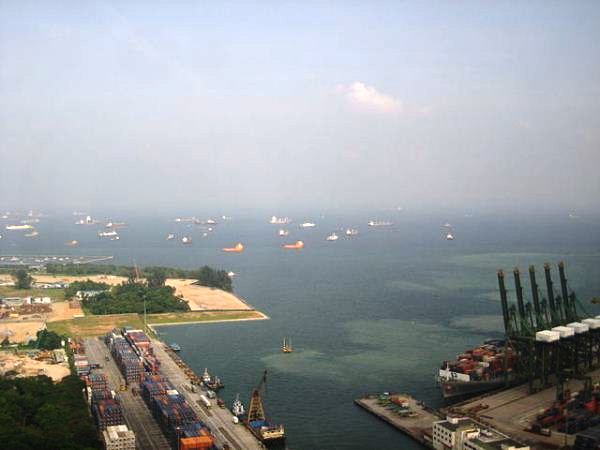
 The Port of Singapore saw flat growth in container throughput in 2016 amidst weaker-than-expected global economic conditions and significant structural changes in the maritime industry, said the Maritime and Port Authority of Singapore (MPA).
Box throughput totaled 30.9 million twenty-foot equivalent units (TEUs) in 2016, similar to 2015.
“Singapore port held its volumes steady despite the challenges—the current poor global economic conditions and lower trade volumes, the collapse of Hanjin Shipping and the uncertainty of shifting alliances,” said MPA.
The total cargo tonnage handled last year increased by 3.0% over 2015 to reach 593.3 million tonnes.
Andrew Tan, chief executive of MPA, said, “2016 was an eventful year for the shipping industry with further changes in the mega-alliances, new mergers and acquisitions, continued excess capacity and depressed rates amidst slower global growth. Despite these challenges, Maritime Singapore sustained its position.”
He said 2017 is expected to be another “pivotal” year. “The maritime industry will not only have to navigate through new geopolitical uncertainties and changes in alliance structures, but also new international regulations that will come into effect this year.”
Annual vessel arrival tonnage increased by 6.3% in 2016 compared to 2015, reaching 2.66 billion gross tonnes (GT). Container ships, bulk carriers, and tankers were the top contributors, each accounting for around 30% of total vessel arrival tonnage.
Singapore remained the world’s top bunkering port in 2016. The total volume of bunkers sold in the Port of Singapore grew 7.7% to 48.6 million tonnes compared to 45.2 million tonnes in 2015.
The Singapore Registry of Ships maintained its growth momentum. Compared to 2015, the total tonnage of ships under MPA’s register grew by 2.0% or 1.7 million GT. In 2016, the total tonnage of ships under the Singapore flag climbed to 88.0 million GT from 86.3 million GT in 2015, consolidating Singapore’s position as one of the top 10 ship registries in the world.
MPA said that last year UNCTAD ranked Singapore as the second most connected country in the world for two years in a row, based on port connectivity, while the World Economic Forum Port Infrastructure Rankings put Singapore as having the second best port infrastructure.
“Singapore continues to attract a diverse range of maritime businesses and is now home to over 130 international shipping groups and more than 5,000 maritime establishments. The maritime cluster employs more than 170,000 people and contributes some seven per cent to Singapore’s Gross Domestic Product,” said MPA.
Photo: DearEdward from New York, NY, USA