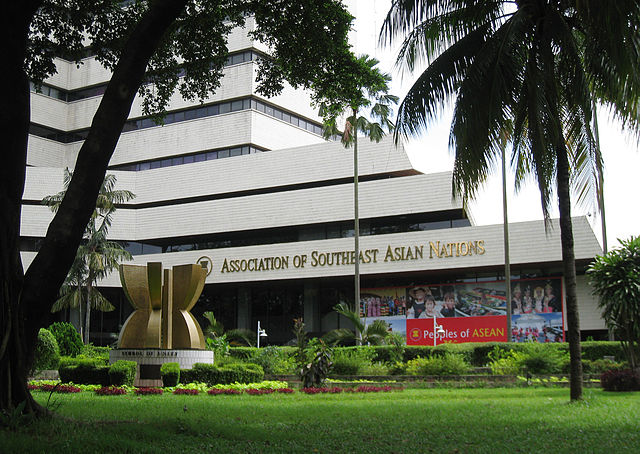

 The ASEAN+3 region is expected to grow by 5.2% in 2017 and 5.1% in 2018 despite the global uncertainty, said a new report by the ASEAN+3 Macroeconomic Research Office (AMRO).
Growth of the two largest member economies, China and Japan, remains stable and robust, and will anchor the continuing growth in the region, according to the inaugural ASEAN+3 Regional Economic Outlook 2017.
The report assesses the regional economic outlook and financial stability in 10 ASEAN countries, and China (including Hong Kong), Japan, and South Korea.
The regional emerging markets of South Korea, ASEAN-5 (Malaysia, Indonesia, the Philippines, Singapore, and Thailand) and Vietnam remain resilient even as volatility in global financial markets persists.
Meanwhile, the developing ASEAN economies of Cambodia, Laos, and Myanmar continue to grow and reap benefits from regional integration.
Among the ASEAN nations, Myanmar is forecast to grow by 7.0% in 2017 and 7.2% in 2018; Laos by 7.0% for both 2017 and 2018; the Philippines 6.8% and 7.0%, respectively; Cambodia 6.8% for both; Vietnam 6.4% for both; Indonesia 5.1% and 5.2%; Malaysia 4.5% and 4.6%; Thailand 3.4% and 3.5%; Singapore 2% and 2.2%; and Brunei Darussalam 1.6% and 2.9%.
China is expected to post GDP growth of 6.5% this year and 6.3% next year, Hong Kong 2.3% and 2.4%, respectively, Korea 2.5% and 2.6%, and Japan 1.3% and 1.1%.
“It is encouraging to see the ASEAN+3 region has been resilient going into 2017,” said Hoe Ee Khor, AMRO chief economist. “Under the current global environment, the region should prioritize financial stability while supporting growth with an appropriate policy mix, including targeted macro-prudential policy measures and sustained structural reform.”
Growth will continue to be driven primarily by domestic demand while individual economies can reap benefits from regional trade and investment integration.
However, the regional outlook is clouded by global uncertainty, including rising trade protectionism, tightening global financial conditions, and rising inflation. Compared to 2016, policy room in monetary and fiscal policy has generally narrowed. Buffers in foreign exchange reserves remain high but the risks of capital outflows from the region are significant amid global policy uncertainty.
A responsive policy framework should be developed to deal with potential external shocks and spillovers, the report recommends.
Urgent structural reforms are also recommended to tackle bottlenecks to growth, including financing infrastructure needs and improving labor productivity.
“Together with their own strengthened domestic policy frameworks and buffers, enhanced regional financial cooperation among ASEAN+3 economies will improve their resilience against shocks and allow their economies to sustain relatively strong growth,” said Khor.
AMRO is an international organization established to contribute to securing the economic and financial stability of the ASEAN+3 region.
Photo: Gunawan Kartapranata