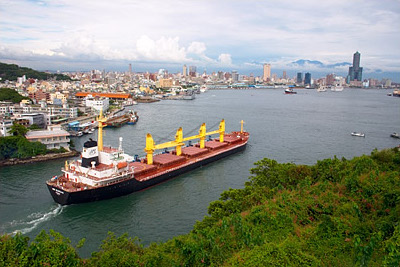
 Taiwan is trying to be ahead of the curve in controlling air pollution from ships, with the Ministry of Transportation and Communications (MOTC) announcing on January 25 a low-sulfur fuel oil rule for ships entering its international ports that will go into effect January 1, 2019.
According to the International Maritime Organization’s (IMO) International Convention for the Prevention of Pollution from Ships, the global limit for sulfur content in fuel oil used in ships will be set at 0.5% mass by mass (m/m) from January 1, 2020.
The current global limit is 3.5% m/m.
Taiwan will therefore be ahead of the times, requiring foreign ships entering its international ports and domestic ships sailing on international routes to use fuel oil that contains 0.5% m/m or less of sulfur starting next year, said Yeh Hsieh-lung, deputy director-general of the MOTC’s Department of Navigation and Aviation.
In an attempt to encourage ships to switch to low-sulfur fuel even earlier, the MOTC will provide between February 1 to the end of the year a subsidy of NTD5,000 (US$172) to all vessels, local and foreign, regardless of size, entering Taiwanese ports, if they make the change before the January 1, 2019 implementation date, according to Yeh.
Photo: DDM Xiao