
The Bureau of Customs (BOC) and the Philippine Coast Guard (PCG) have signed a memorandum of agreement (MOA) on the guidelines for conducting anti-smuggling joint operations within Philippine borders.
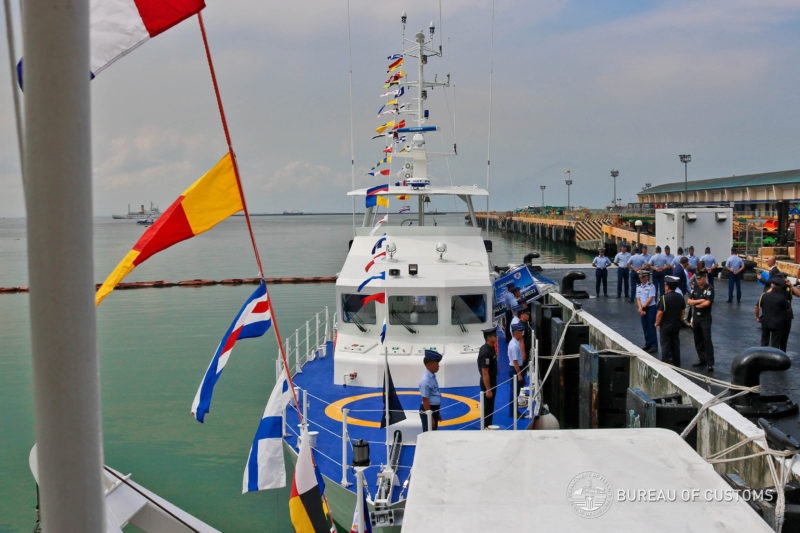
Under the MOA, PCG has agreed to the use of three of its fast patrol vessels (FPV) to conduct joint operations in enforcing border control, preventing the entry of smuggled goods, and suppressing smuggling and other forms of customs fraud.
PCG has four FPVs that are primarily used to enhance the agency’s capability during disaster response and relief operations, enforce maritime laws, and monitor wharves and ports.
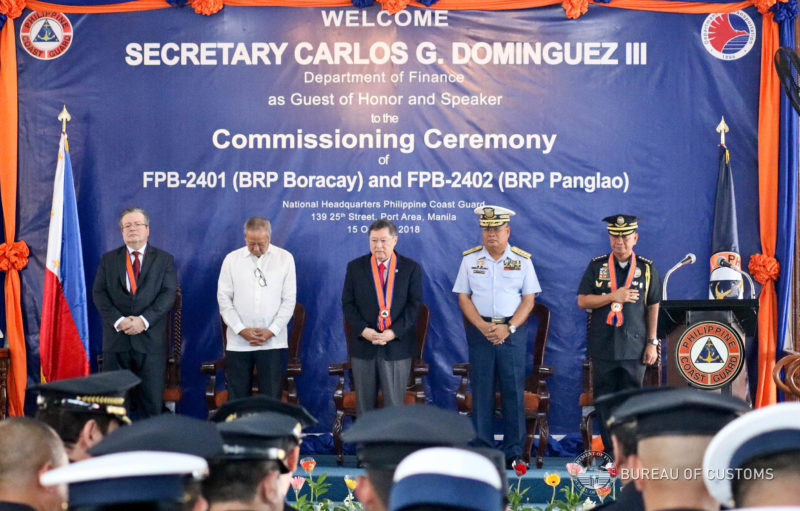
The MOA signing on October 15 was led by Customs Commissioner Isidro Lapeña and PCG Commandant Elson Hermogino, witnessed by Finance Secretary Carlos Dominguez III.
Under the MOA, the parties shall jointly perform law enforcement functions on board the three FPVs.
BOC, for its part, has agreed to closely coordinate with PCG in operating the FPVs to be used in customs operations. BOC, as stated in the agreement, shall be responsible for issuing the sailing orders when the FPVs are needed for its law enforcement operations.
 Four customs officers and one customs police officer with a rank not lower than special police lieutenant will be assigned on board the FPVs during BOC-led and joint agency- related operations.
To perform their functions, BOC and PCG are authorized by law to board, inspect, search, and examine all types of merchant ships and watercraft and any container, trunk, package, box, or envelope found on board, and to physically search and examine any person aboard the ships within the Philippine customs territory and maritime jurisdiction.
Losses from smuggling
Meanwhile, Dominguez has called for closer coordination between BOC and PCG in mounting a relentless drive against smuggling.
Dominguez said eradicating smuggling is crucial because the billions of pesos in annual revenue losses from this illicit activity could have been enough to kick-start the country’s overdue infrastructure modernization program long before the current administration implemented its “Build, Build, Build” initiative.
“Being an archipelago with twice the coastline of the United States, we have long been vulnerable to smuggling activities,” Dominguez said during the October 15 commissioning ceremony for the two FPVs acquired by the Philippines with the assistance of the French government.
“There is no way to accurately estimate the cumulative amount of revenues denied government coffers. But we are sure that the amount is immense, far more than whatever we might be investing today in improving our enforcement capabilities,” he added.
Dominguez said that “the cumulative amount of lost revenues from smuggling could have enabled the government to ramp up spending on infrastructure and social services much sooner than the government had planned. Our economic development might have taken a much preferable course. Our people might be more prosperous than they are now.”
Meantime, the two newly commissioned vessels—FPB-2401 and FPB-2402—were named, respectively, the BRP Boracay and BRP Panglao. Aided by the French administration, the Philippine government acquired four FPVs, of which three will be used jointly by the BOC and PCG under their MOA.
The third FPV is expected to arrive by the end of the year.
To sustain today’s investments in the “Build, Build, Build” program as well as those in social services and human capital development, Dominguez said the administration needs to improve the state’s revenue collection capabilities and thwart efforts to divert revenues due to the government.
He said PCG and BOC should be prepared to combat such efforts, including the smuggling of illegal drugs into the country.
“I expect very close coordination between the Coast Guard and the Bureau of Customs in the effort to curb smuggling activities. The two agencies are the sharp edges of a single sword. That coordination is the key to winning this war against smugglers,” Dominguez said.
He called on customs personnel assigned to man the newly commissioned patrol boats to “use these assets intensively and well.”
“We did not invest in these new vessels for them to be used sparingly. The war against smuggling should be unrelenting,” Dominguez said. “Go forth then, and get the job done. Our people will benefit hugely from your success.”