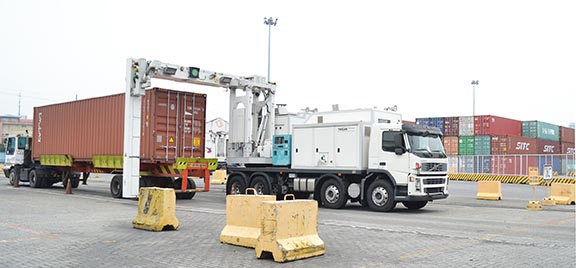

 The Bureau of Customs (BOC) has released rules on the implementation of the square root scheme when selecting cargoes for non-intrusive examination at the ports of Cagayan de Oro (CDO) and Davao.
Customs Memorandum Order (CMO) No. 16-2018 notes that the new guidelines fall under BOC’s mandate, as prescribed in the Customs Modernization and Tariff Act (CMTA), to facilitate trade without compromising its border control and anti-smuggling functions.
It adds that the guidelines will also ensure the fast release of legitimate imported goods and prevent congestion at the ports of CDO and Davao.
CMO 16-2018, signed October 11, took effect immediately.
Square root rule is an algorithm used by BOC to inspect multiple containers in a consignee’s single shipment that is tagged under the red lane of BOC’s selectivity system. Being tagged for the red lane means that the shipment needs to undergo physical inspection, and that BOC can inspect a certain number of containers, and not all, for compliance. However, CMO 16-2018 specifically pertains to the non-intrusive inspection of selected shipments in the two ports.
CMO 16-2018 covers the non-intrusive examination of shipments of government agencies including government-owned and controlled corporations, multinational companies as registered with BOC’s Account Management Office (AMO), and Philippine Economic Zone Authority (PEZA)-bound shipments that arrive at the ports of CDO and Davao, including their subports where x-ray machines are deployed and operational.
Non-intrusive examination of all shipments that are selected from the parameters set by BOC’s Risk Management Office and that consist of four and more containers, regardless of size, declared under one import entry and covered by one bill of lading (B/L), shall be under the mandatory square root scheme rounded off to the nearest whole number. CMO 16-2018 states, for example, that two out of four containers will be subject to x-ray inspection, three for every six, and three as well for every nine containers.
The field officer or, in his absence, the assistant field officer, of BOC’s X-ray Inspection Project (XIP) Field Office, shall randomly choose the specific containers to be scanned after applying the square root scale.
All other containers not randomly selected for non-intrusive examination shall not be cleared for release from customs territory until all selected containers have undergone x-ray inspection and been cleared by the XIP Field Office.





