
 The last mile of delivery is increasingly becoming the key battleground in the e-commerce supply chain, and companies that can develop targeted strategies to improve performance in this area will emerge as the winners, according to new research by global logistics company DHL and market research service Euromonitor.
With over 600 million more people forecast to live in urban environments by 2030 and new technologies creating opportunities for both service enhancement and disruption, online retailers and their logistics partners are being challenged to embrace bold new approaches in order to survive and compete, according to the white paper, “Shortening the Last Mile: Winning Logistics Strategies in the Race to the Urban Consumer.”
In the report, DHL and Euromonitor point out how increasing urbanization is making the last mile of delivery more complex and critical for the success and survival of e-commerce companies.
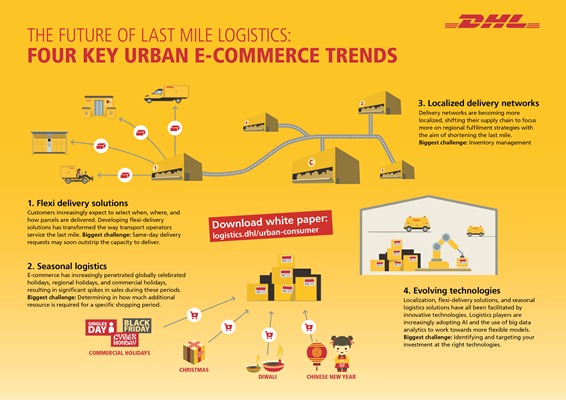
They have identified the four main trends shaping urban last-mile transportation—localized delivery, flexi-delivery networks, seasonal logistics and evolving technologies—and ways in which companies can adapt their supply chains to the changing market environment and achieve competitive advantage.
“The last mile is increasingly becoming the key battleground in the e-commerce supply chain, and companies will have to develop targeted strategies in this area to compete effectively,” said Katja Busch, chief commercial officer, DHL.
“It’s not just about transportation, but about companies’ overall approach to managing inventory—getting the right items to the right place at the right time. DHL is developing focused solutions to help e-commerce companies reach their end customers quickly and efficiently, from using machine learning to better route shipments within cities to adding more automation to our delivery networks.”
The white paper found that the major urban trends all create various challenges in terms of cost, service impact, and organizational strain. For example, the growth of seasonal logistics as a result of increasingly popular holidays and promotional days such as Asia’s Singles’ Day or national Cyber Days places significant pressure on logistics companies to build up additional capacity and hire resources to cope with short-term volume surges, which can in turn be difficult to predict,” said the paper.
Urban customers’ demands for speed and convenience are forcing retailers to overhaul their warehousing networks, replacing centralized networks with local fulfilment and distribution infrastructure, which can require more accurate balancing of inventory.
Evolving technologies are creating opportunities for new disruptive challengers to enter the market, while also requiring incumbents to invest prudently and incorporate new skills into their workforce.
To overcome these challenges, DHL and Euromonitor have jointly identified the F.A.D. (Flexible transport networks, Automation and Data) model as a framework that will help retailers and logistics operators to ensure their competitiveness over the last mile. By improving their performance in increasing automation, managing data and building flexibility into their networks, e-commerce companies in all markets will be able to better manage inventory and increase the efficiency of their last-mile delivery networks.
“The future evolution of this fast-moving, highly competitive e-commerce market is still incredibly difficult to predict, so companies need to remain nimble and efficient while ensuring they are meeting customer demands,” said Lee Spratt, CEO, DHL eCommerce Americas.
“The last mile requires considerable attention because, however the market evolves, it will continue to be one of the main touchpoints in the customer experience. Those companies that can build effective partnerships to make their urban delivery networks more elastic, invest in the most effective technologies to boost productivity, take advantage of data to build better customer experiences and, most importantly, manage their inventory as efficiently as possible will emerge as winners in the dynamic e-commerce marketplace of tomorrow.”
Infographic source: DHL