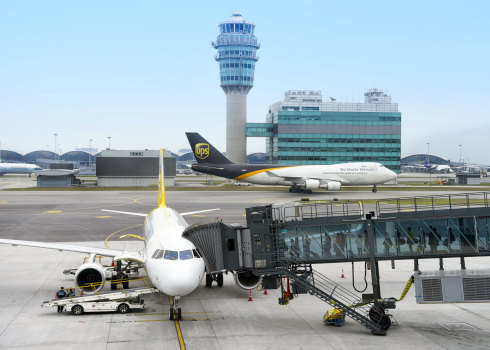
 Airport Authority Hong Kong (AA) has outlined its strategy to transform Hong Kong International Airport (HKIA) into an “airport city” to “secure and strengthen HKIA’s status as an international aviation hub through rigorous development of various segments of the airport.”
In a report titled “From City Airport to Airport City” released May 29, 2019, the AA said the ongoing transformation integrates the airport with many functions surrounding it, turning it into a much bigger entity—an airport city—that drives the economic growth of Hong Kong and the region.
“Today, airports have become not only entities to manage the flows of passengers and cargo, but also breeding grounds for much wider networks of interrelated activities and businesses. Such networks, surrounding or radiating from an airport with many functions akin to a city, form a much bigger entity—an Airport City,” the report said.
The AA outlines a strategy that comprises rigorous development of various segments of the airport—core passenger and cargo services, multi-modal regional connectivity, and commercial developments including retail, entertainment and hotels, conventions and exhibitions.
“In recent years, these different segments have notably accelerated their interconnected, synergistic development—culminating in the form of an Airport City that has begun to take real shape. This trend is set to continue over the next decade and beyond,” it said.
The AA’s airport city vision echoes the Outline Development Plan for the Guangdong-Hong Kong-Macao Greater Bay Area (GBA) which has designated Hong Kong as the region’s international aviation hub, and is also in line with the Hong Kong government’s Lantau Tomorrow Vision which aims to reinforce Lantau’s role as a “Double Gateway” to the world and the GBA.
Development of the airport city calls for infrastructural and functional enhancements, as well as a flexible planning approach which allows the airport to be more responsive to market changes and trends, which in many ways are driven by new technologies.
For this reason, a three-pronged development strategy has been mapped out, represented by three key words: infrastructure, innovation and destination.
Infrastructure underpins the airport city. In the coming years, the focus of major infrastructure development at HKIA will remain on the construction of the Three-runway System (3RS), targeted for completion and commissioning in 2024, said AA.
In tandem, a series of expansion projects has been planned and executed in the past few years, including the expansion and refurbishment of Terminal 1, and the building of a new premium logistics center at the airport’s South Cargo Precinct.
As for innovation, HKIA, under its smart airport strategy, has been investing in new technologies to enhance services and operational efficiency. “The airport business of today—and increasingly so of tomorrow—is about services and innovation, which are largely driven by developments in technology,” it explained.
On destination as part of its strategy, AA said leading airports around the world all vie to become destinations in themselves. HKIA’s proposition is SKYCITY—an integrated commercial development providing a full suite of retail, dining, entertainment facilities as well as offices and hotels.
The SKYCITY will cater to the increased passenger volume brought by the 3RS and a number of infrastructure projects connecting to the airport, such as the Tuen Mun-Chek Lap Kok Link and the Hong Kong-Zhuhai-Macao Bridge.
Photo courtesy of HKIA