The Department of Transportation (DOTr) said it has completed 17 commercial airport projects, with 28 more projects currently ongoing, in the first three years of the current administration’s term.
DOTr said that during the period it has built two new international airports—the Lal-Lo International Airport in Cagayan, and the Philippines’ first eco-airport, the Bohol-Panglao International Airport.
Fifteen other existing gateways have also been upgraded, of which two are international and 13 domestic.
Under rehabilitated international airports, the Mactan-Cebu International Airport (MCIA), hailed as the world’s friendliest resort airport, opened its new passenger terminal building (PTB) last year, boosting annual capacity to 13.5 million passengers. The project was awarded to the concessionaire in 2014.
The Puerto Princesa Airport’s PTB was also expanded, and its runway extended to accommodate larger aircraft.
Last July 9, Ormoc Airport’s new facilities, including a renovated PTB and a widened runway, were inaugurated.
Additionally, infrastructure developments for the domestic airports of Virac, Marinduque, Tuguegarao, San Vicente, and Busuanga in Luzon; Maasin, Tacloban, and Catarman in the Visayas; and Ipil, Camiguin, and Siargao in Mindanao have been accomplished.
DOTr, together with the Civil Aviation Authority of the Philippines (CAAP), is also accelerating the ongoing infrastructure development at 27 commercial airports and one military air base. The government is likewise set to build one more international airport, DOTr noted.
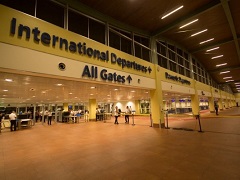
Rehabilitation works for Ninoy Aquino International Airport’s (NAIA) Terminal 2 continue as well. These include the expansion of the departure check-in hall and arrival baggage area; architectural improvements in passenger movement areas; upgrade of aerobridge areas and elevated roadway; new glass wall panels and partitions; upgrade of air-conditioning system, power, lighting, fire protection, and electronics and communications systems; installation of an improved flight information display system and a new public address system; and waterproofing works for the building’s exterior.
As the NAIA rehabilitation continues, DOTr said the government is also working to decongest the main gateway through complementary infrastructure development.
Additional facilities at the Sangley Airport in Cavite are now under 24/7 construction to meet the November 2019 deadline of President Rodrigo Duterte for the military air base to commence general aviation and turboprop operations.
Construction is also ongoing for the second PTB of Clark International Airport (CRK). The expansion is seen to increase the CRK’s overall capacity to 12.2 million passengers annually. An additional runway is also set for construction.
To further aid in the long-term decongestion of NAIA, plans are underway for the proposed New Manila International Airport project in Bulacan. Opening of bids is on July 31, 2019.
Meanwhile, Bicol International Airport is now more than halfway complete. Targeted for completion in 2020, the airport is expected to accommodate two million passengers per year once finished.
International airports in Davao, General Santos, Zamboanga, Iloilo, Kalibo, and Laoag are also undergoing improvements.
Development projects continue as well for domestic airports in Busuanga, Cauayan, Naga, and Tuguegarao in Luzon; Bacolod-Silay, Calbayog, Catbalogan, Dumaguete, and Tacloban in the Visayas; and Bukidnon, Ipil, Laguinduingan, Mati, M’lang, Ozamiz, Sanga-Sanga, Siargao, and Surigao in Mindanao.
CAAP director general Jim Sydiongco said the public can expect more airport development projects and programs to be completed in the remainder of the current administration’s term.
“A number of airports we have rehabilitated were in a dismal state when we took over. We are proud of what we have already accomplished, but we know that we can do more. With the guidance of our hardworking Secretary Tugade, we will continue to build, build, build towards the ‘Golden Age of Infrastructure’,” Sydiongco said.
“Connectivity and mobility in transport are key components in socio-economic development. By building new airports and rehabilitating existing ones, the transportation sector contributes to both regional and national progress,” DOTr secretary Arthur Tugade said.
Aside from developing airports, major programs and initiatives have been launched to further uplift aviation and airports services, such as the establishment of a new communications, navigation, surveillance / air traffic management system that now covers 100% of Philippine airspace, and the night-rating of 15 more commercial airports to further ease decongestion in major gateways.