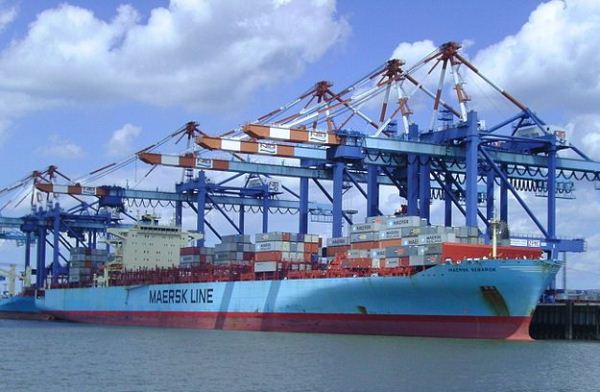

 Danish shipping and logistics group A.P. Moller-Maersk said it made “solid progress” in the second quarter by delivering profit above expectations, and reaffirmed its guidance for the whole year.
Maersk, the world’s largest container shipping company, reported a 17% increase in earnings before interest, taxes, depreciation and amortization (EBITDA) to US$1.4 billion in Q2 compared to the same quarter last year. This performance was “mainly driven by an improvement in Ocean, supported by higher freight rates, increased volumes and strong operational execution leading to improved unit cost, partly offset by a subdued macro environment,” it said.
Revenue grew slightly to $9.6 billion, which is on par with last year, and the underlying profit increased to $134 million from $15 million in the second quarter of 2018.
“Q2 was a quarter of solid progress. EBITDA was up 17% and cash flow improved 86% year on year, driven by continued recovery in Ocean,” said group CEO Soren Skou.
On the back of the increases in volume and freight rates, ocean EBITDA in the second quarter increased 25% to $1.1 billion. The ocean business continued to recover with enhanced unit cost, utilization and reliability and revenue grew 2.9% to $7.2 billion compared to Q2 2018.
Revenue in terminals & towage grew 13% to $957 million compared to Q2 last year. In gateway terminals, volume in Q2 grew by 8.5% compared to last year, leading to higher utilization. EBITDA increased by 11%, partly offset by one-off items.
In logistics & services EBITDA grew to $61 million in the second quarter compared to $52 million in the same period last year. Revenue was at $1.5 billion, positively impacted by increased revenue in supply chain management, but offset by declining revenue from sea and air freight forwarding.
Meanwhile, EBITDA for the first half of the year improved by $500 million to $2.6 billion, while revenue rose to $19.2 billion from $18.9 billion in the first six months of 2018.
Maersk reiterated its full-year guidance for 2019 of an EBITDA of around $5.0 billion.
The organic volume growth in ocean is still expected to be in line with the estimated average market growth of 1% to 3% for 2019, it said.
“We reaffirm our guidance for 2019, while the macro environment continues to be subject to considerable uncertainties,” said Skou.
The guidance continues to be subject to considerable uncertainties due to the weaker macroeconomic conditions and other external factors impacting container freight rates, bunker prices and foreign exchange rates.
Photo: Tvabutzku1234