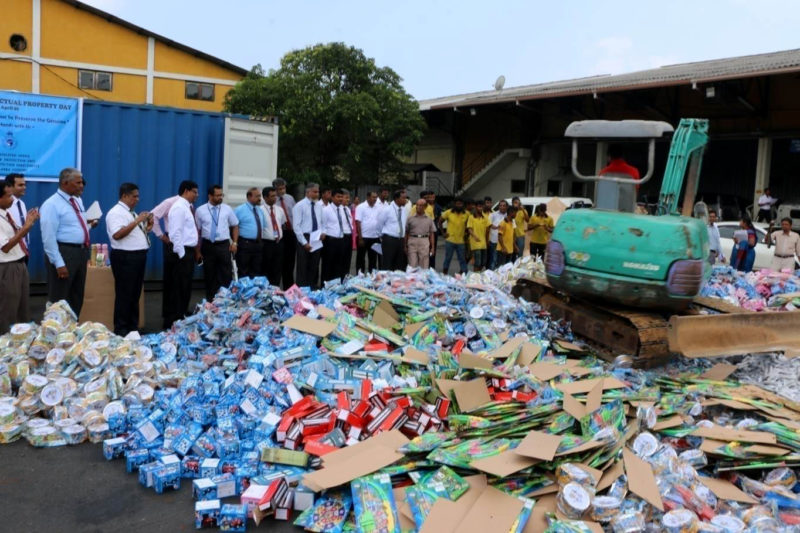
MORE than 80 customs officials from ASEAN and Europe met in Manila last week to talk about best practices and learn new techniques in combating the spread of counterfeit goods and piracy.
The seminar was within the framework of the EU-ASEAN Intellectual Property Rights Cooperation Program which aims to establish a modern and enforceable system for the protection of intellectual property rights while fostering trade.
The trade in counterfeit goods is a major concern in globalization. According to the Organization for Economic Cooperation and Development (OECD), pirated goods comprise 5-7% of the global trade volume five years ago or an equivalent of 460 billion euro.
Christophe Zimmerman, a customs expert from the European Commission, said the internationalization of fraud calls for a harmonized approach in customs operations.
“The techniques applied in Europe have brought about more efficient and effective seizure of counterfeit goods at the borders of Europe, resulting in an increase of seized articles from 10 million in 1998 to 87 million in 2002,” he said.
Zimmerman disclosed a significant percentage of counterfeit goods originates from the Asian region, with Thailand manufacturing the most number at 43%, followed by China at 15%.
He said the EC has come upon 7,000 cases of counterfeits in the Asian region in 2002. Of these, 8% were from Turkey, 5% from Hong Kong, and 3% from Malaysia. Only 2% came from the United States.
ASEAN governments equally share the concern over continuing trade in counterfeit goods. “We make fighting piracy and counterfeiting our serious business,” said Intellectial Property Office (IPO) deputy director general Pacifico Avenido, Jr.
Apart from depriving government of revenue, the sale of counterfeit “has also become a lucrative route for organized crime syndicates and has been a major source to finance terroristic activities,” Avenido noted.
Among the measures adopted by the IPO is the establishment or creation of an IP Enforcement Section to boost the fight against IPR violations.
Guy Platton, an EC delegate in the seminar, said the economic cost of fakes is rising. A study conducted by the European Chamber of Commerce of the Philippines revealed that aggregate sales of products of 11 multinational corporations being copied stood at over P3 billion in 2001. This translates into an estimated government tax revenue loss of over P1 billion.
He also expressed concern over the health and safety of consumers who are ultimately affected.
Counterfeit and pirated goods now include a wide range of consumer products ranging from pharmaceuticals, foodstuffs / beverages, personal care items to electronics, tools and autoparts. Luxury goods account for less than 1% of these articles.