
 Despite the global and regional economic slowdown, the Philippine economy continues to show its strength with a positive performance in the first half of the year, the Asian Development Bank (ADB) said in its update of the Asian Development Outlook 2012.
As a result, ADB bumped up gross domestic product (GDP) growth forecasts for the Philippines from 4.8 percent to 5.5 percent in 2012, but said the economy needs to create more job opportunities to link economic growth to poverty reduction,
“Increased business confidence bodes well for investment and future jobs,” said ADB chief economist Changyong Rhee. “But the Philippines must guard against weaknesses outside its own economy that could have a knock-on effect.”
Stronger-than-expected economic growth in the first half was broadly based. Private consumption was buoyant, fixed capital investment quickened, public spending rebounded, and net exports contributed to growth. Inflation remains under control at 3.5 percent for 2012.
GDP growth for 2013 is forecast at 5 percent, unchanged from early projections. In 2013, inflation is forecast at 4.1 percent on the back of higher global food prices, as well as pressures from sustained strength in domestic demand. But softer demand from industrialized countries than forecast in the report could undermine export and investment prospects for the Philippines, ADB said.
The service sector is expected to continue to benefit from robust private consumption and investment. The business process outsourcing industry employed about 638,000 Filipinos in 2011, and this number is expected to rise by at least 20 percent by year end.
Although the number of new jobs has grown by one million over the past year, this only slightly exceeds overall growth in the labor force, and mainly reflects a rise in part-time employment.
“The key challenge is to link economic growth to poverty reduction. Despite solid economic growth, job generation remains inadequate, reflected in rates of unemployment and underemployment. The incidence of poverty remains high at 26.5% in 2009, compared to 26.4% in 2006 and 24.9% in 2003,” said Neeraj Jain, ADB’s country director for the Philippines.
Manufacturing will also benefit from a gradual recovery in exports and growth in domestic demand. Construction, meanwhile, will benefit from public infrastructure spending and implementation of public-private projects.
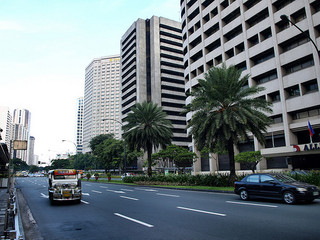
Photo: Jun Acullador