
 Global passenger traffic moderated in the first half of 2019, while the air freight industry, including in the Asia-Pacific region, continued to experience downturn as the sector reeled from trade tensions, new airport traffic data from Airports Council International (ACI) World showed.
The global passenger market grew by 3.9% year-over-year, up from 3.1% in May. Year-to-date growth reached 3.6%, almost one percentage point below its 12-month rolling average.
After falling by 2.8% in May, the global freight market fell again, by 5.1% in June. Total freight volumes declined 3.2% for the first half of the year.
“The global passenger market managed to sustain its growth rate in June compared to the previous month,” ACI World director general Angela Gittens said. “While year-to-date results show a slight slowdown, the industry continues to show resilience in the face of the weakened global economy.
“The trade tensions that persist between several major economies—and the accompanying GDP growth slowdown—have had more impact on the air freight industry, which could possibly end 2019 in the negative.”
The international passenger market was the main driver in the overall passenger industry’s regained momentum in June. The international segment posted a 5.7% year-over-year growth rate, two percentage points above May’s results.
The mid-year growth for international passenger traffic stood at 4.9% year-to-date, close to twice the gains posted by the domestic market during the same period (2.5%). The latter gained 2.3% in June, slightly below its 2.4% gain in May.
Asia-Pacific remained the lowest performer of the major regional markets in June, gaining 2.1%. The region ended the first half of the year with 1.9% growth year-to-date. With rising tensions between Japan and South Korea, and the continuing trade spat between China and the United States, 2019 may result in loss for Asia-Pacific’s major economies.
“After being the driver of growth for the global air transport industry for the past several years, the current trend represents a major shift in the near-term,” said ACI.
Europe had the highest growth rate in June, with 4.7% on a year-over-year basis. The region’s growth rate stood at 4.3% for the first half of the year, having just sped ahead of North America.
North America stood at +3.9% by the end of the second quarter. The region’s total passenger traffic grew 2.9% on a year-over-year basis in June. Unlike Asia-Pacific and Europe, North America’s domestic market remained relatively strong during the first half of the year.
Africa continued to grow significantly in June, gaining 12.3% year-over-year. Year-to-date results for the region stood at +7.1%, the highest of all regions.
The Middle East posted the second highest growth in June, after Africa, with 8.1% gain year-over-year. The last 12 months have been challenging for the Middle East, resulting in a 2.5% growth for the first half of the year. Latin America-Caribbean grew 6% for the month. The region’s mid-year results were the second highest after Africa, at 5.5%.
On the other hand, the international freight market continued to decline in June. Year-over-year results reached -5.1% during the month, bringing the mid-year figure to -3.2%. The domestic segment, mostly due to North America and Europe’s robust performance, remained in the positive, at +1.3% for the first half of the year.
Asia-Pacific continued its decline in June, with total freight volumes falling by 6.5%, bringing its year-to-date growth rate to -5.9%. Both of its freight markets were negative for the first half of the year, at -3.6% for the domestic segment and -6.7% for the international segment.
North America was the only major region with a positive year-to-date growth rate, having gained 0.5% for the first half of the year, driven by the domestic market.
Europe contracted by 7% in June, bringing its results to -4.4% for the first half of the year.
Latin America-Caribbean declined by 6.3% in June, bringing its results to -1.9% for the first half of the year.
Africa’s air freight industry was, along with North America, one of the two regional markets with positive growth for the first half of 2019. Its year-to-date result reached +1.6%.
The Middle East’s air freight industry fell by 7.1% in June, bringing the region’s year-to-date growth rate to -2.7%.
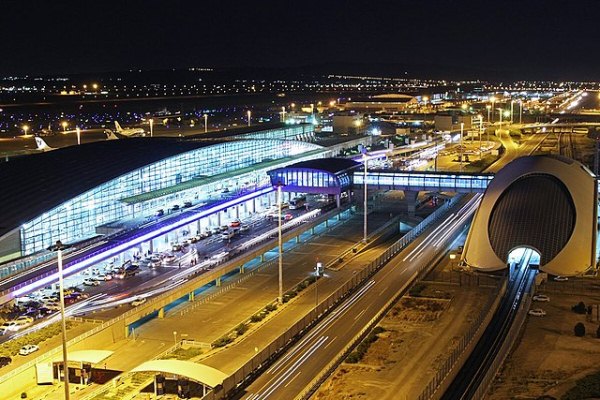
Photo: Imam Khomeini Airport City