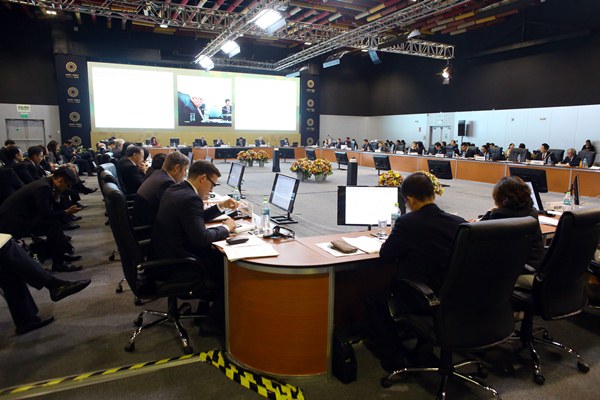

 A more low-key approach to advancing the notions of free trade and regional economic integration, including the creation of a Free Trade Area of the Asia-Pacific (FTAAP), is at the core of the meetings of leaders and ministers from the 21 members of the Asia-Pacific Economic Cooperation (APEC) this week in Lima, Peru.
“The need for a new, progressive direction for globalization and trade that opens up job creation, enhances social mobility and increases wages is up against a diminishing appetite for policies that could foster this outcome,” explained Dr. Alan Bollard, executive director of the APEC Secretariat.
“APEC’s voluntary, incentive-driven approach differentiates it from other, legally binding economic integration mechanisms that may raise red flags over sovereignty issues and incite domestic anxiety,” he continued.
“In the current environment, the region’s soft approach to globalization and trade could be the best way forward. It offers incremental, yet significant change that is not just tolerated but actually welcomed by all corners of society.”
The executive’s pronouncements come as high-ranking officials from the APEC member-economies convene this week to re-shape globalization and trade policy as concerns over APEC’s capacity to deliver more inclusive socioeconomic progress escalate in the region and beyond.
Tackling stagnant trade-driven growth and rising skepticism of globalization will be a core agenda focus. The aim is to expand economic opportunities for groups that have reaped fewer benefits from open, integrated markets in the past, improving growth and living standards for the 3 billion people of a region that accounts for half of trade and 60% of GDP worldwide.
“There is a firm belief across APEC in the enduring power of globalization and trade to build prosperity in the region,” said Ambassador Luis Quesada, 2016 chair of APEC Senior Officials. “The advantages of these forces must be more evenly felt to sustain public confidence in them.”
Actions on the table center on advancing regional economic integration and quality growth. This includes bolstering the underpinnings of next-generation trade agreements and the ultimate realization of an APEC-wide FTAAP, e-commerce and other emerging services sectors, and the cultivation of the regional food market amid increasing demand and climate change-related threats.
The leaders and ministers will also prioritize establishing conditions that make participating in cross-border trade and supply chains easier for small businesses. Support for more business-compatible, productive work forces through education reform and enhanced skills development and career training is a further emphasis.
APEC brings together all the major economies in the Asia-Pacific region: Australia, Brunei Darussalam, Canada, Chile, China, Hong Kong and Taiwan, Indonesia, Japan, the Republic of Korea, Malaysia, Mexico, New Zealand, Papua New Guinea, Peru, the Philippines, Russia, Singapore, Thailand, the United States, and Vietnam.