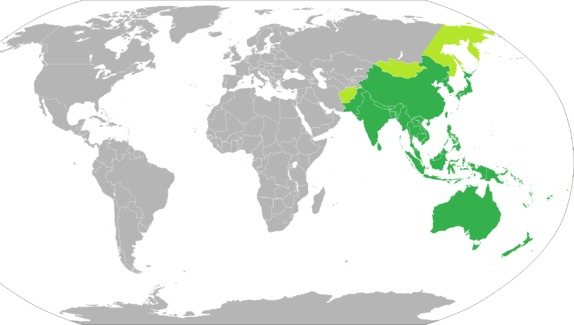

 Ministers and high-level officials in Asia-Pacific have committed to advance regional economic cooperation and integration (RECI) to support the implementation of the 2030 Agenda for Sustainable Development.
The ministerial declaration was adopted at the conclusion of the United Nations Second Ministerial Conference on RECI in Bangkok, Thailand on November 24, according to a statement from the Economic and Social Commission for Asia and the Pacific (ESCAP).
Governments at the conference, jointly organized by ESCAP and the Asian Development Bank, have agreed to continue working together across four key areas.
These include promoting market integration by striving to reduce trade costs through trade facilitation, and addressing trade protectionism; developing seamless connectivity across the region in transport, energy, and ICT; enhancing financial cooperation in domestic resource mobilization, financial inclusion, capital markets, and public-private partnerships; and addressing shared vulnerabilities and risks to mitigate the impact of disasters, environment degradation, and climate change.
With a combined GDP of US$27.25 trillion that is growing rapidly, Asia-Pacific is well on its way to becoming the largest market in the world, opening possibilities for further expansion of trade and investment within the region. This could help boost economic growth, create jobs, and reduce poverty.
However, to take advantage of such opportunities, participants recognized that the region needs to enhance RECI. They highlighted that RECI should be consistent with the principle of leaving no one behind and that it must be consistent with the Sustainable Development Goals in contributing to social progress and environment sustainability.
Addressing the ministerial segment of the conference, UN Under-Secretary General and Executive Secretary of ESCAP Dr. Shamshad Akhtar said that several key principles should underpin efforts to take RECI a step further. “Priority assistance must be given to countries with special needs—including through capacity building and technical assistance—to ensure they can take full advantage of deep economic integration.
“For example, as countries move towards the conclusion of the Regional Comprehensive Economic Partnership, or embark on Free Trade Area of the Asia-Pacific, it is essential they undertake a sustainability impact analysis of their membership in such mega-regional endeavors to design and execute negotiation mandates that will result in development oriented provisions in line with long term sustainable development goals and aspirations for shared prosperity.”
At the same time, she said, gender equality, and female participation in our economies should be hardwired into RECI work.
“And we must improve our ability to measure our progress by strengthening the quality of our data and statistical systems across Asia and the Pacific,” she added.
Photo: Abrahamic Faiths