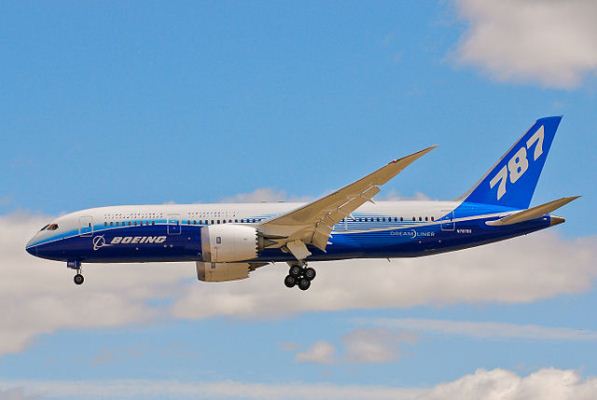
 Asian airlines continue to modernize and upgrade their fleets with new orders from aerospace firm The Boeing Company at the recent Paris Air Show.
Korean Air on June 18 announced plans to add 30 new 787 Dreamliner airplanes to its fleet, with a commitment to purchase 10 new 787-10s and 10 additional 787-9 airplanes valued at US$6.3 billion at current list prices, Boeing said in a release.
As part of this agreement, Korean Air will also lease ten 787-10s from Air Lease Corporation.
The airline, one of the largest trans-Pacific carriers in Asia with 16 nonstop routes to North America, will introduce the larger 787-10 to complement its long-haul fleet of 787-9 and 777 airplanes.
“As we continue to innovate our product offering, the 787 Dreamliner family will become the backbone of our long-haul fleet for many years to come,” said Walter Cho, chairman of Korean Air.
“In addition to 25 percent improved fuel efficiency, the stretched 787-10 offers around 15 percent more space for passengers and cargo than our 787-9s, which will be critical to our long-term business goals,” he added.
With this order, Korea’s flag carrier will quadruple its 787 fleet to 40 airplanes as it looks to strengthen its long-haul fleet.
Korean Air operates a fleet of 96 Boeing passenger airplanes, including the Next-Generation 737, 747, 777, and 787 airplanes. The airline also operates an all-Boeing cargo fleet with the 747-400, 747-8, and 777 Freighters.
With a fleet of 168 aircraft, the carrier is one of the world’s top 20 airlines and serves 126 destinations in 44 countries worldwide.
Meanwhile, Taiwanese flag carrier China Airlines announced on June 19 its intent to order up to six Boeing 777 Freighters to modernize its cargo fleet.
The airline plans to transition to the world’s largest and longest range twin-engine freighter as it launches operations from Taipei to North America and Europe—two key markets that provide higher yields for the carrier.
“Air cargo is an important part of our overall business and the introduction of these new Boeing 777 Freighters will play an integral role in our long-term growth strategy,” said China Airlines chairman Hsieh Su-Chien.
“As we transition our Freighter fleet to the 777Fs from the older 747Fs, this will enable us to deliver world-class services to our customers more efficiently and reliably.”
The 777 Freighter is capable of flying 9,200 kilometers with a maximum payload of 102,010 kilograms. The airplane will allow China Airlines to make fewer stops and reduce associated landing fees on these long-haul routes, resulting in the lowest trip cost of any large freighter and superior ton-mile economics.
In addition, the 777 Freighter features market-leading capacity for a twin-engine freighter, accommodating 27 standard pallets, measuring 96 inches by 125 inches on the main deck. This allows for lower cargo handling costs and shorter cargo delivery times.
China Airlines operates 51 Boeing airplanes. The addition of 777 Freighters will enable the carrier to streamline maintenance and parts for its 777 fleet.
On the other hand, compatriot EVA Air on June 21 took delivery of its first Boeing 787-10 Dreamliner, the first of twenty 787-10s the carrier plans to use on high-density routes within Asia later this summer. The airline, which is also celebrating its 30th anniversary this year, already operates a fleet of four 787-9 Dreamliners.
“The 787 Dreamliner has become the flagship of our fleet and we will leverage the airplane’s unrivaled fuel efficiency, reliability and size to operate in high-density markets in Asia,” said Steve Lin, chairman of EVA Air, the second largest Taiwanese airline.
Built with lightweight composite materials and powered by advanced GEnx engines, EVA Air’s 787-10 is the largest member of the fuel-efficient and passenger-pleasing Dreamliner family. At 68 meters long, EVA Air’s 787-10 can serve 342 passengers in a two-class configuration, which is 38 more seats than EVA Air’s 787-9 Dreamliner.
A member of Star Alliance, EVA Air serves international routes with about 565 weekly flights.
Photo: Jose A. Montes