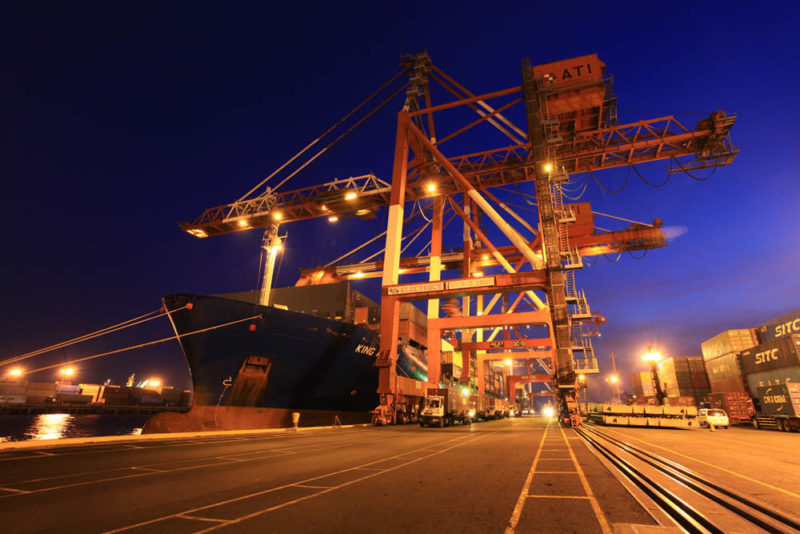


Listed port operator Asian Terminals Inc. (ATI) said its first-semester results got a boost from the sustained growth of international containerized cargoes at its two terminals in line with an expanding Philippine economy.
In a disclosure to the local bourse, ATI reported a net income of P1.19 billion for the first six months of the year on the back of robust international container volumes handled by both Manila South Harbor and Batangas Port facilities. This figure is up 16.8% from P1.02 billion a year earlier.
ATI’s total revenues for the period stood at P5.07 billion, 15.3% higher than P4.40 billion recorded for the first half of 2016.
From January to June 2017, Manila South Harbor handled just short of 550,000 twenty foot equivalent units (TEUs), sustaining its strong performance coming off a record-breaking year in 2016 when it handled over one million TEUs for the first time.
Batangas Container Terminal (BCT), which caters to the Calabarzon (Cavite, Laguna, Batangas, Rizal and Quezon) area, handled over 93,000 TEUs by mid-year, keeping it on track to exceed its 2016 record volume of nearly 160,000 TEUs.
Despite growing volumes, “our international container ports in Manila and Batangas are performing at optimum production and utilization levels heading into the ‘ber’ months, the peak season for shipments,” ATI executive vice president Andrew Hoad said in a statement.
“We have capacity for future volume growth,” Hoad assured.
As of end-July, quay crane production at BCT stood at 31 gross moves per crane per hour (GMPH), while yard utilization remained below 50%, demonstrating the terminal’s capacity to handle more ships and cargoes.
At Manila South Harbor, crane production has hit 30 GMPH, while yard utilization remains at an optimum 70%.
GMPH is an efficiency measure indicating how fast a quay crane moves containers from ship to shore in an hour, which redounds to faster vessel turnaround time and quicker delivery of cargoes to consignees.