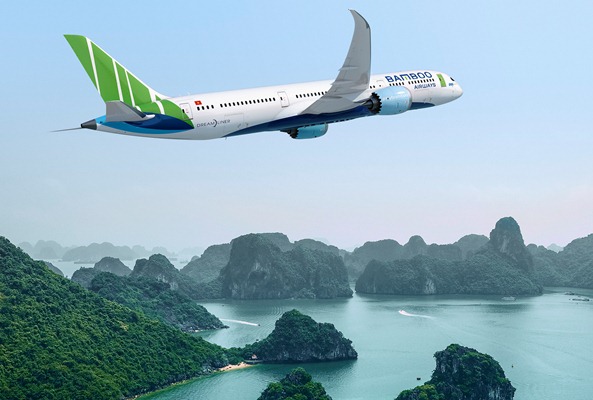
 U.S. airplane maker Boeing and newly launched Vietnamese hybrid airline Bamboo Airways have confirmed an order for ten 787-9 Dreamliners valued at US$3 billion according to list prices, part of the airline’s plan to launch new international routes.
The order for the super-efficient and longest-range member of the Dreamliner family was unveiled during a signing ceremony in Hanoi, Vietnam, witnessed by U.S. President Donald Trump and General Secretary and President of Vietnam Nguyen Phu Trong, Boeing said in a statement released February 27.
“We are excited to be adding the new 787 Dreamliner to our growing fleet,” said Trinh Van Quyet, chairman of FLC Group which owns Bamboo Airways. “Our long-term vision is to connect Vietnam with key markets in Asia, Europe and North America and the Dreamliner will enable us to launch these long-haul operations.”
This order was previously unidentified on Boeing’s orders & deliveries website, said Boeing.
Last year, FLC and Bamboo Airways signed a contract to purchase 24 A321NEO aircraft with Airbus in France in March, and inked a contract to purchase 20 Boeing B787-9 Dreamliner aircraft with Boeing in the United States in June 2018.
Bamboo Airways, a startup airline founded in 2017, began commercial operations last January, offering flights linking the capital of Hanoi and Ho Chi Minh City with other cities in Vietnam. The airline plans to offer up to 40 domestic routes in 2019.
Additionally, Bamboo Airways is preparing to launch international services to the U.S., Thailand, South Korea, Singapore, Japan, Taiwan, and Australia, before broadening operations to other destinations in Asia, Europe, and North America.
It reportedly plans to fly to the U.S. later this year or early 2020, looking at routes to Seattle, Los Angeles and San Francisco, following the clearance given to Vietnam recently by the U.S. Federal Aviation Administration to operate direct flights to the United States.
“The 787 Dreamliner’s unmatched efficiency, range and flexibility make it the perfect airplane for Bamboo Airways to achieve its long-range ambitions,” said Kevin McAllister, president and CEO of Boeing Commercial Airplanes.
The 787 Dreamliner family allows airlines to fly long ranges while reducing fuel costs by more than 20% compared to previous widebody jets. The Dreamliner’s superior efficiency and range have allowed airlines to open more than 210 new nonstop routes around the world since it entered service.
At 63 meters (206 feet), the 787-9 can fly 290 passengers, in a typical two-class configuration, up to 7,635 nautical miles (14,140 kilometers). The airplane is 6 meters longer than the original Dreamliner and is capable of carrying more passengers and flying farther.
Bamboo Airways is wholly owned by the FLC Group, a Vietnamese multi-industry company focusing on aviation, real estate, resorts, farming, and golf.
FLC earlier said of the airline, “This is the first Vietnamese carrier to operate on a hybrid model, combining the flexibility of a traditional airline with reasonable cost, to provide a service that addresses the diverse needs of every customer segment.”
Bamboo Airways is the fifth air carrier in Vietnam after national flag carrier Vietnam Airlines, budget operators Jetstar Pacific and Vietjet Air, and Viet Nam Air Service.
Photo from Boeing