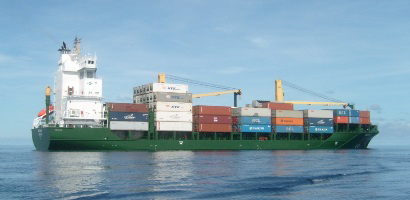
 Singapore-based MCC Transport will make a maiden call at the Batangas International Container Port, 110 kilometers south of Manila, on December 10, according to Sean L. Perez, vice president of Asian Terminals Inc (ATI).
A wholly-owned subsidiary of the A.P. Moller-Maersk Group, MCC Transport will call at the port on its weekly inbound service (every Saturday) from Singapore, off loading at Batangas Port before sailing to Manila, then to Kaohsiung, and Hong Kong.
“MCC, which can carry up to 1,400 containers, is committed to work with us. It will come in even at 100 TEUs because it recognizes the potential within this leg. It hopes to develop inbound cargoes initially then attract outbound shipments later,” said Perez in a recent meeting to discuss developments at Batangas Port. The meeting was organized by the Export Development Council (EDC)/National Competitiveness Council (NCC) at the Philippine Economic Zone Authority (PEZA) office with Lilia B. De Lima, PEZA director general, in attendance.
De Lima welcomed the development, noting it will help decongest Manila and lower the cost of doing business in the Cavite, Laguna, Batangas, Rizal, and Quezon (Calabarzon) region.
“Our idea is for PEZA locators in Calabarzon to use Batangas International Container Port to ease traffic flow in and through the Manila ports. At the same time, the shorter transit time from Batangas Port to (PEZA locators’) plants in the region can help increase their cost competitiveness,” said De Lima.
The Port of Batangas is managed by ATI Batangas Inc, a subsidiary of ATI. It operates a passenger terminal (Phase 1) which handles approximately two million embarking passengers annually.
The cargo terminal has two berths: the foreign berth, 185 meters long and with a draft of 10.5 meters; and the multi-purpose berth 230 meters long and with a draft of 12 meters. The terminal is ideal for general and bulk cargoes.
Batangas Port has a newly operational international container terminal (Phase 2) equipped with two ship-to-shore cranes and other modern cargo stacking equipment. It has an annual throughput of 400,000 TEUs.
Statistics from the Philippine Ports Authority showed container traffic at Phase II of the Port was only 11,607 TEUs from January to September this year, over 6,800 TEUs of which were domestic-bound.
Based on PEZA records, 86% of total manufactured exports come from PEZA. Of this number, 70% are from Calabarzon which, De Lima pointed out, indicates there is enough volume in the region to influence shipping routes to be re-directed to the Port of Batangas.
The advocacy to increase sea cargo traffic through Batangas Port in the south and the Port of Subic in the north is also being pushed by the EDC, NCC and the Philippine Exporters Confederation.
Photo from http://www.mcc.com.sg/About-



