 The multi-billion-dollar Beijing Daxing International Airport completed its first passenger airline test flight as four aircraft landed safely on the runway on the morning of May 13.
China Southern Airlines, China Eastern Airlines, Air China, and Xiamen Airlines sent their flagship models A380, A350-900, B747-8 and B787-9, respectively, for the test, reported Xinhua News.
No passengers were on board, only officials of the Civil Aviation Administration of China (CAAC) and those of the airlines.
“The test shows that the new airport has now turned its focus from infrastructure construction to operation preparations,” said Wan Xiangdong, chief pilot of CAAC.
The test followed the airport’s first flight of verification planes on January 22 this year. The airport is scheduled to take two more tests before it is put into use. One is a specialized test for low-visibility situations, the other is a full-scale test set for August this year.
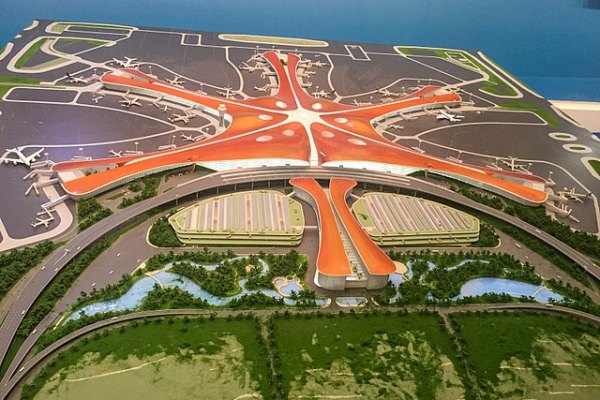
Beijing Daxing International Airport, located on the border of Beijing and Langfang, Hebei Province, is the capital city’s second international airport. Construction of the airport began on December 26, 2014 and the hub is nearing completion, The terminal building, the second largest single-building airport terminal after Istanbul Airport, is expected to be completed on July 15, 2019, and the airport is expected to open on September 30, 2019.
Upon completion, Beijing Daxing International Airport will serve as a major international hub airport in Northern China and is predicted to become the world’s largest airport, rivaling Hartsfield-Jackson Atlanta International Airport. There will be four runways, and about 80 aircraft stands, most of which can be configured to handle either one twin-aisle or two single-aisle aircraft. The airport is expected to handle 45 million passengers annually by 2021 and 72 million by 2025.
It is also expecting a total of seven runways and another terminal to the south of the current one in the future, in order to accommodate 620,000 flights and 100 million passengers each year.
Reportedly, construction of the airport has cost nearly US$12 billion so far. On completion, it will serve as a second international airport for Beijing, designed to relieve existing pressure on Beijing Capital International Airport.
Photo: N509FZ