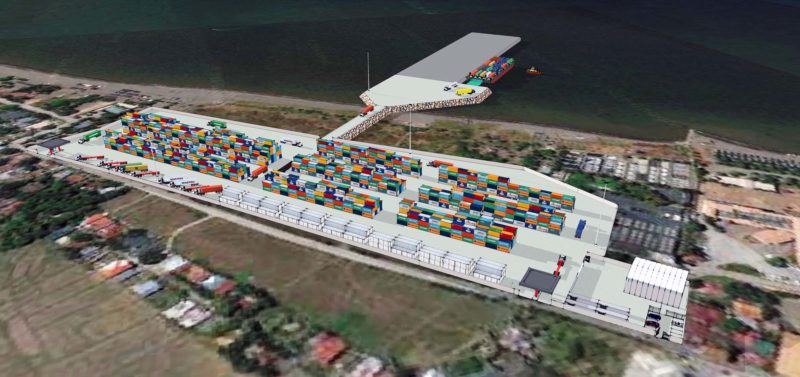
The Cavite Gateway Terminal (CGT), the country’s first container roll-on/roll-off barge terminal in Tanza, Cavite, will start soft operations by the second quarter of this year, according to an official of port operator International Container Terminal Services, Inc. (ICTSI), which owns the terminal.
Full operation is targeted by the third quarter.
ICTSI senior vice president and head of Asia Pacific region and Manila International Container Terminal (MICT) Christian Gonzalez, in a recent chance interview with PortCalls, said the only issue that needs deciding prior to opening is how initial equipment can be transferred to the terminal.
Built on a six-hectare property owned by ICTSI, CGT was formally launched in April 2017. According to ICTSI, the terminal will facilitate seaborne transfer of containers between ICTSI’s flagship terminal MICT and Cavite.
For the soft opening, Gonzalez said empty containers will be barged from Cavite Economic Zone Authority (CEZA) to MICT.
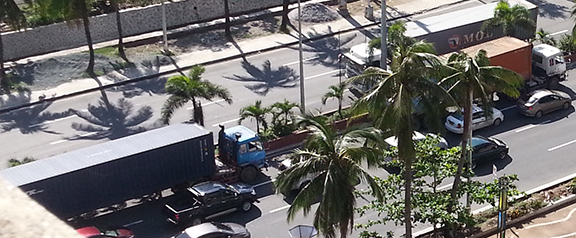
He noted there’s “still a struggle on the road” and “we don’t want to repeat mistakes of the past where hindi sapat ‘yung road capacity (isn’t enough)”; the empties from CEZA will therefore be used to gauge “how much we can really put without disrupting the communities on the existing road.”
CGT is seen to potentially reduce truck trips on city roads by 140,000 annually.
Plan for a 4-lane road
Gonzalez said there are plans by the local government of Cavite and ICTSI to build a new four-lane road to add capacity which, “if push comes to shove”, will be financed by ICTSI.
He noted, however, that ICTSI is working with the Department of Public Works and Highways and Department of Transportation on project financing.
ICTSI, together with partners freight forwarder Orient Freight International, Inc. and marine services provider Harbor Star Shipping Services, Inc., will operate CGT.
Gonzalez in 2016 said instead of truck bans and other regulations, “we came up with a solution (CGT) that’s been tried and tested in other places around the world, which is to use waterways which are not congested, which are very efficient, which will be cheap, and which essentially allow the development of more economic activity in the province of Cavite.”
Phase 1 of the terminal has a projected cost of US$30 million. In an earlier statement, ICTSI said part of the group’s $380-million capital expenditure for 2018 will fund completion of CGT, which will be Philippine Economic Zone Authority-bonded.
Phase 1 involves a pier and yard infrastructure, equipment, and support facilities. The first phase can accommodate a total of 115,000 twenty-foot equivalent units (TEUs) per year.
Succeeding phases of CGT will be built to support increases in capacity in anticipation of annual volume growth in the Cavite market, home to a number of economic zones.
Earlier, Orient Freight chairman Monchu Garcia said there are about 240,000 containers annually for CEZA locators alone. – Roumina Pablo