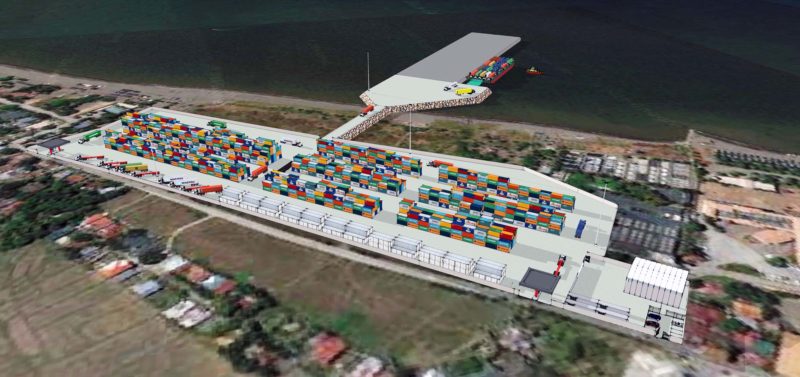
With construction now 90% complete, the first phase of the Cavite Gateway Terminal (CGT), the Philippines’ first container roll-on/roll-off (Ro-Ro) barge terminal, located in Tanza, Cavite, is all set for launching before the end of June, according to the Department of Transportation (DOTr).
The transport department, in a statement, said over 300 workers are on a 24/7 schedule to construct CGT’s first phase, which when finished can accommodate barges and will have 550 ground slots for containers.
DOTr said travel time at sea is estimated at two to three hours, with initial multiple pick-up locations from the ports of Manila and Batangas, and later from Subic.
The agency claimed the terminal is an “original concept of Secretary (Arthur) Tugade,” and is “aimed at decongesting Metro Manila traffic by reducing the number of cargo trucks plying its roads by 50%.”
“Malaking tulong ang proyektong ito para maibsan ang parating dinaraing na traffic ng mga motorista sa Metro Manila, lalo na ng mga working class. Kahit papaano ‘pag nawala iyong mga mahahabang truck na katumbas ng hanggang tatlong sasakyan, mararamdaman natin ang kaunting ginhawa [The project will be a big help in easing traffic for motorists in Metro Manila, especially the working class. They will start to feel the effect once the long trucks that are as long as almost three vehicles are gone],” Tugade said in a statement.
Built on a 6-hectare property owned by port operator International Container Terminal Services, Inc. (ICTSI), CGT was formally launched in April 2017 to facilitate seaborne transfer of containers between ICTSI’s flagship terminal Manila International Container Terminal (MICT) and Cavite, according to the port operator.
ICTSI chairman and president Enrique Razon earlier said that “businesses will now have an alternative way to move cargo to and from the Port of Manila and the economic zones of Cavite via container barges plying the Manila Bay.”
“This should significantly relieve Metro Manila road traffic of container trucks,” he added.
CGT is now ready to receive containers as it has set up temporary facilities for handling shipments, ICTSI senior vice president and the head of Asia Pacific Region and Manila International Terminal (MITC) Christian Gonzalez told PortCalls in an earlier interview.
Gonzalez also clarified that CGT will be a “common-use facility” for barge operators, a condition set down by DOTr when it approved the unsolicited proposal.
“They want to make sure that this is a completely commercially viable opportunity for anybody that wants to use it,” he added, noting that ICTSI has already released the indicative rates.
At the same time, ICTSI is working with the municipal government of Tanza on constructing a four-lane road “to make sure that the long-term viability of the facility is there as the volume increases” and to “get the trucks through without any disruption to the community.”
Earlier, too, Gonzalez told PortCalls that DOTr was working with the Department of Public Works and Highways on the project and its financing. However, he said that “if push comes to shove,” ICTSI would finance the project.
On when the road will be constructed and completed, Gonzalez said “definitely by next year.”
CGT is seen to potentially reduce truck trips on city roads by 140,000 annually.
Gonzalez in 2016 said that instead of truck bans and other regulations, “we (CGT) came up with a solution that’s been tried and tested in other places around the world, which is to use waterways which are not congested, which are very efficient, which will be cheap, and which essentially allow the development of more economic activity in the province of Cavite.”
Phase 1 of CGT has a project cost of US$30 million. In an earlier statement, ICTSI said part of the group’s $380 million capital expenditure for 2018 will be used to fund completion of CGT, which will be Philippine Economic Zone Authority-bonded.
Phase 1 involves pier and yard infrastructure, equipment, and support facilities, and can accommodate a total of 115,000 twenty-foot equivalent units (TEUs) per year.
Succeeding phases will support increases in capacity in anticipation of annual volume growth in the Cavite market, home to a number of economic zones. From CEZ locators alone, 240,000 containers are already handled annually, according to freight forwarder Orient Freight International Inc. president Monchu Garcia. – Roumina Pablo