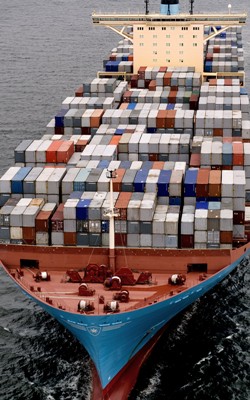
 Ocean container carriers could lose as much as $5.2 billion in 2011 despite a projected global container growth of 6.5 percent, based on 3Q11 financials and year-end industry dynamics assessed by London-based Drewry Maritime Research.
The culprits for the losses were overcapacity, poor headhaul growth on the major east-west routes, and the continued fight for market share among the lead players, which eroded spot rates by more than 50 percent on the key headhaul routes by end-2011, Drewry said in its latest quarterly “Container Forecaster.”
“Even attempts by carriers to cull capacity during November and December did not act as a catalyst to lift rates by any meaningful margin. Spot rates have improved a little as of early January, but this is still likely to be a temporary phenomenon driven by the annual spike before Chinese New Year,” a Drewry statement on January 4 read.
This year will be “another challenging year for liner operators,” according to the quarterly, as uncertainties swirl over the strength of global demand, and the delivery of big ships looms.
The drive to place the largest ships in every major trade to remain competitive on slot costs has caused a major shift in the network configuration for the Asia-Europe trade, Drewry said. It led to a number of carriers clubbing together to share costs and ships and to challenge the “Daily Maersk.
The service structures will be finalized by April 2012, although many carriers will continue to receive big ships throughout the rest of this year, it added.
“With three major groupings in place, the remaining small players with sub 8,000 teu ships will find it extremely difficult to survive in this intense environment,” Drewry said.
The analyst forecasts a growth of 25 percent in 2012 for the global fleet above 8,000 TEUs.
“This will be a severe challenge for the industry to absorb, given that we foresee decent demand growth only in the emerging markets of Latin America, Indian Subcontinent, Africa and intra-Asia where sub-8,000 teu ships operate,” it said.
The current supply/demand fundamentals on the key east-west trades are not strong enough for carriers to push through any sustained revenue increases and some shipper contracts have been signed on the Asia-Europe trade this year for around $1,100 per 40-foot all in—levels that are below break-even.
“We believe that at the current burn rate, carriers’ cash reserves will run out during the second half of 2012. If they do not put a substantial amount of tonnage into lay-up by this time, the consequences could be dire,” Neil Dekker, Drewry’s head of container research, stated.
At the moment, relatively few vessels from suspended services are being laid up or idled, with most being re-chartered or absorbed into other routes. However, Drewry estimates that idling could reach as much as 8 percent of the global fleet during second half of 2012, or about 1.3 million to 1.4 million TEUs.
“Carriers will at some stage in 2012 be forced to idle tonnage, even if the lead players are showing no inclination to do so at the moment. This will enable a partial recovery in spot rates during the second half of this year,” Dekker said.
Meantime, the industry will continue to change its structure as all stakeholders adapt to the difficult conditions. But Dekker said they still do not foresee any company acquisitions, as was the case in 2009. “Consolidation is more likely to happen through the disappearance of small players.”
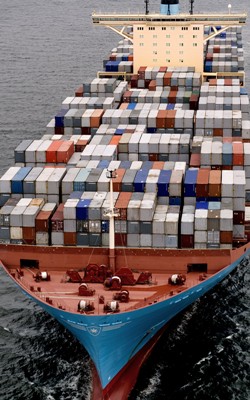
Photo from Maersk Line