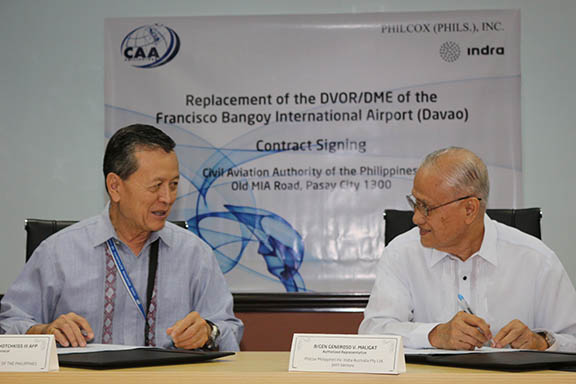
Civil Aviation Authority of the Philippines chief Lt Gen (ret) William Hotchkiss III (left) with Brigadier General (ret) Generoso Maligat, Indra Philippines representative, at the awarding of the air traffic management system to install a new navigational system at the Francisco Bangoy International Airport (Davao International Airport). Photo courtesy of CAAP.
Civil Aviation Authority of the Philippines chief Lt Gen (ret) William Hotchkiss III (left) with Brigadier General (ret) Generoso Maligat, Indra Philippines representative, at the awarding of the  air traffic management system to install a new navigational system at the Francisco Bangoy International Airport (Davao International Airport). Photo courtesy of CAAP.
Civil Aviation Authority of the Philippines chief Lt Gen (ret) William Hotchkiss III (left) with Brigadier General (ret) Generoso Maligat, Indra Philippines representative, at the awarding of the air traffic management system to install a new navigational system at the Francisco Bangoy International Airport (Davao International Airport). Photo courtesy of CAAP.

The Civil Aviation Authority of the Philippines (CAAP) will install a new navigational system at the Francisco Bangoy International Airport (Davao International Airport) to help pilots land successfully on the runway under adverse conditions such as bad weather and low visibility.

CAAP has awarded air traffic management system provider Indra Australia Pty. Ltd. and its joint venture partner Philcox (Phils), Inc. the contract to replace the old system at the Davao airport with a new Doppler VHF Omnidirectional Range (DVOR) and Distance Measuring Equipment (DME).

The DVOR/DME is a short-range radio navigation system that enables an aircraft to determine its position and stay on course as it heads for the runway through radio signals transmitted by a network of fixed ground radio beacons, with the receiver unit using radio frequencies in the very high frequency (VHF) band.

This navigation system is a critical tool used in the air traffic industry to assist pilots in locating and landing on the runway at night and in times of inclement weather and poor visibility.

Aside from commissioning the supply and installation of the equipment and the flight check of the new DVOR/DME system, the project also calls for installing new underground power, as well as other grounding, electrical and mechanical requirements, and rehabilitating the existing Doppler counterpoise and shelter system.

This is the third major project CAAP has awarded through competitive bidding, in line with the modernization of navigational systems in the Philippines. The first was for the navigational aid equipment at the Ninoy Aquino International Airport, with the new DVOR/DME system already operational since November 2014.

The second project, a DVOR/DME system upgrade, was commissioned for the Mactan-Cebu International Airport early this year and is scheduled to be completed before the end of 2015.

You May Also Like

NEDA to decide on fate of P9B Cebu international seaport

The Department of Transportation and Communications (DOTC) will seek approval from the National Economic and Development Authority (NEDA) Board to construct a P9-billion international…

Save for 3 countries, DA suspends PH poultry imports amid bird flu flare-up

The Philippine Department of Agriculture (DA) has banned the importation of all poultry products, including dressed and deboned chicken, eggs, and ducks, except those…

Indonesia’s Boom Baru port invests in new equipment

Cargo-handling time at Boom Baru port in Indonesia has become faster with the installation of new loading and unloading equipment at the port located…

PAL gears for launch of new Manila-Saipan flight

Flag carrier Philippine Airlines (PAL) is all set to fly to Saipan twice a week starting June 15 this year to serve the needs…