
 The European Commission and the Association of Southeast Asian Nations (ASEAN) propose to take aviation cooperation to a new level by negotiating a comprehensive bilateral air transport agreement.
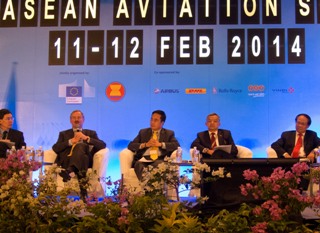
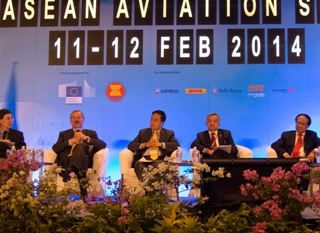
In a joint declaration adopted February 12 in Singapore at the end of the two-day EU-ASEAN Aviation Summit, EU and ASEAN leaders including transport ministers discussed the opportunities in a close cooperation in aviation activities.
They cited such benefits as greater market access, integration of air services, efficiency of air traffic management, and harmonization of safety and security standards.
“If Europe works together with ASEAN to the fullest extent, we can extend the proven benefits of our respective single aviation markets to a much larger inter-regional one,” said Siim Kallas, European Commission vice president in charge of transport.
“The summit has created much new momentum for closer cooperation and made a convincing case for embarking on what could be a first aviation agreement in the world between two important blocs of countries like the EU and ASEAN.”
Sommad Pholsena, Minister of Public Works and Transport of Laos and current chairman of the ASEAN Transport Ministers, said: “Both sides stand to benefit significantly from even closer cooperation. Apart from allowing both sides to better capitalize on the opportunities in and the capabilities of each other, a bloc-to-bloc agreement would also facilitate further intra-ASEAN integration by allowing ASEAN to learn from the EU’s experience in developing a single aviation market since the 1990s.”
To negotiate an agreement with ASEAN, the European Commission will need a negotiating mandate from the Council of Transport Ministers of the 28 EU member-states.
Kallas announced that he will propose to the EC to seek authorization from the Council of the European Union to start negotiations on an EU-ASEAN comprehensive air transport agreement.
ASEAN’s first air transport agreement as a bloc was with China in 2011. The region has also initiated discussions with Japan and South Korea toward concluding similar air transport agreements.
The EU has negotiated comprehensive air transport agreements with the United States, Canada, Morocco, the Western Balkan countries, Jordan, Georgia, Moldova, and Israel, and an agreement is expected to be signed in March 2014 with Ukraine. Negotiations are expected to be completed with Brazil in the near future, and negotiations are ongoing with Azerbaijan, Tunisia, and Lebanon.
Air traffic between the EU and ASEAN has been growing steadily in recent years and has nearly doubled over the last 15 years to reach more than 10 million passengers in 2012, said an ASEAN statement. “With a combined population of 1.1 billion, the EU-ASEAN air transport market is of increasing strategic importance to both sides with an expected average growth rate of 5 percent per year over the next 20 years.”
Half of the world’s traffic growth over the next 20 years will be to, from, or within the Asia-Pacific region, which will become the world leader in air traffic by 2030 with a market share of 38 percent. ASEAN, with its rapid economic development and rising incomes, will be at the very center of this development, the statement continued.
ASEAN is developing by 2015 a single aviation market which will have many similarities to the single aviation market of the EU.