 International air cargo maintained in February 2013 the modest improvement in demand that began in the fourth quarter of 2012, according to the latest data from the International Air Transport Association (IATA).
After adjusting for the extra day due to the Leap Year and for the Chinese New Year break, air cargo volume in February this year was up 2 percent compared to the previous year.
“February’s air cargo performance has sustained the weak recovery that began in the fourth quarter of 2012. This is welcome news after two consecutive years of contraction. It is even better news that this growth is expected to pick up moderately as the year progresses,” said Tony Tyler, IATA’s director general and CEO.
Air cargo volumes declined by 0.6 percent in 2011 and a further 1.5 percent in 2012. Markets stabilized and began a weak recovery trend in the last quarter of 2012, IATA said.
But Tyler cautioned that the euro zone crisis, as shown by the events in Cyprus, was far from over. “Any resulting loss of business confidence could shift the outlook for the worse,” he added.
By region, Asia-Pacific carriers saw a 14.7 percent fall in freight traffic compared to February 2012 owing to the impact of factory closures during the Chinese New Year holiday. But IATA said Chinese business confidence levels are increasing and being supported by rising employment and trade activity.
Also seeing freight demand declines for the month were North America (3.1 percent drop) and Europe (5.4 percent).
A good performer during the period was the Middle East with 12.3 percent growth year-on-year, as airlines in the region continued to benefit from increased trade activity with emerging economies in Asia and Africa. Also doing well were Latin America and Africa, where airfreight demand rose by 2.9 percent and 2 percent, respectively.
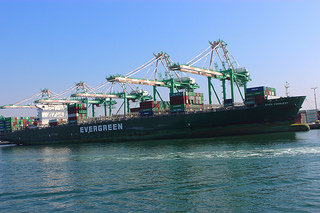
Tyler said the global economy seemed to have bottomed out in the third quarter of 2012, and industrial production and business confidence measures had been improving since then. But he warned that ocean transport was gaining on the aviation industry.
“Demand for sea shipments already reflects the recovery in some parts of the world. But we are not yet seeing the positive impact of this in air cargo markets. While it remains to be seen if this is a long-term modal shift, it is clear that sea shipping is becoming a stronger competitor to air cargo,” said Tyler.
Photo: Ever