Hapag-Lloyd announced a round of general rate increases (GRIs) on the East Asia-U.S. and Canada trades effective mid-January next year.
The GRIs will be implemented for all dry, non-operated reefer, flat-rack and open-top containers from East Asia to all U.S. and Canada destinations from January 15, the German ocean carrier said.
The rate hikes to the U.S. West Coast, Vancouver and British Columbia Province are US$480 per 20-foot-equivalent unit (TEU), $600 per 40-foot-equivalent unit (FEU), $675 per 40-foot high-cube container, and $760 per 45-foot container.
The rate increases for Asian shipments bound for the U.S. East Coast, U.S. IPI and RIPI locations, Toronto, Montreal, Halifax all-water, and all other Canada inlands are $640 per TEU, $800 per FEU, $900 per 40-foot high-cube container, and $1,012 per 45-foot container.
The Hamburg-based box ship will also impose a GRI of $500 per TEU for the East Asia-Mexico, Central America, and South America West Coast loops, effective January 15, 2013. The increase applies to all cargo and all container types on these trade lanes.
East Asia includes Japan, Korea, Taiwan, Hong Kong, China, Vietnam, Laos, Cambodia, Thailand, Myanmar, Malaysia, Singapore, Brunei, Indonesia, Philippines, and Russian Pacific Coast Provinces.
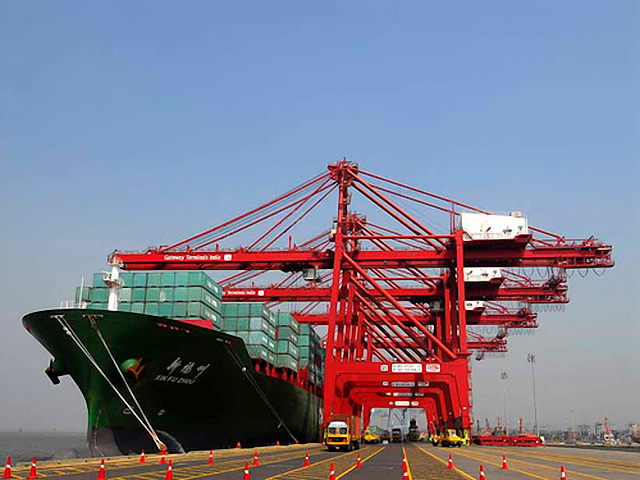
Photo courtesy of Hapag-Lloyd