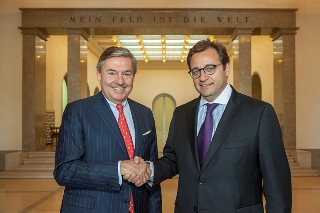


Germany’s Hapag-Lloyd has moved up to fourth place among the world’s largest box shipping lines after merging with Compañía Sud Americana de Vapores (CSAV) of Chile.
The two ocean carriers signed late last week a binding contract merging CSAV’s entire container business with Hapag-Lloyd, bringing the latter up the rankings from sixth to fourth largest shipping liner in the world.
The integration boosts Hapag-Lloyd’s fleet to some 200 vessels with total transport capacity of around one million TEUs (20-foot-equivalent units), annual transport volume to 7.5 million TEUs, and combined turnover to EUR9 billion (US$12.4 billion).
The company will keep its head office in Hamburg, Germany, and will have a regional office in Chile for its Latin America business.
For contributing its container business, CSAV will become a new Hapag-Lloyd core shareholder besides HGV (City of Hamburg) and Kühne Maritime. CSAV will initially hold a 30 percent stake in the combined entity. The partners have agreed on a capital increase of EUR370 million once the transaction has been concluded, to which CSAV will contribute EUR259 million. This will then increase its share of Hapag-Lloyd to 34 percent. A second capital increase of EUR370 million will be linked to Hapag-Lloyd’s planned stock exchange listing.
“I am delighted that we have succeeded in concluding this partnership through which our two companies are playing an active part in consolidating the liner shipping industry. This day is an important milestone in the history of Hapag-Lloyd,” said Michael Behrendt, group chairman, upon signing the agreement.
“By joining forces, we are creating a stronger, larger and more global company with significant economies of scale and a considerably improved competitive position,” said Oscar Hasbún, CEO of CSAV.
“The combination with CSAV, Latin America’s leading container shipping line, considerably strengthens Hapag-Lloyd in this growth market and adds a strong position in the North-South traffic to the company’s global network and to its established strength in East-West traffics,” he added.
A joint official statement played up the benefits of the unification. Their combination will result in annual synergies of at least $300 million, and service networks and fleets of both companies complement one another ideally.
Order books are also complementary. At the end of April, Hapag-Lloyd will put into service the last of ten 13,200-TEU vessels ordered for the Far East trade, and CSAV still has seven vessels for the South American trade, each of 9,300 TEUs, scheduled for delivery in 2014 and 2015.
“This means that we will have a young and cost-efficient fleet. The use of optimum tonnage in the trades is one of the key prerequisites for successful operations in the face of international competition,” said Hasbún.
“By integrating CSAV’s container business, Hapag-Lloyd is able to build on its strengths and is therefore in an excellent position for future growth,” said Behrendt. “This combination will further strengthen our service portfolio and enable us to deliver an even better global service to our clients.”
The corporate bodies of both companies have already approved the merger, which is subject to the approval of competition authorities.





