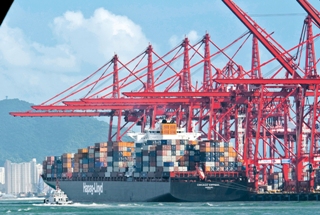

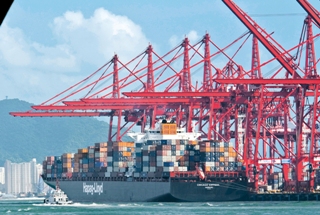
 Hapag-Lloyd will implement general rate increases for all cargo and container types from the eastbound and westbound Far East-North Europe slings, the German ocean carrier said.
The freight rate hikes take effect on June 4.
Rates for all cargo and all container types from North Europe and the Mediterranean to East Asia, Indian Subcontinent, and the Middle East will rise by US$225 per TEU (20-foot equivalent unit), according to the world’s fourth largest container carrier.
North Europe comprises North West Continent, the U.K., Scandinavia, the Baltic, and the European ports of Russia.
The Mediterranean comprises the West Mediterranean, East Mediterranean, Black Sea, and North Africa.
East Asia comprises Japan, Korea, Taiwan, Hong Kong, China, Macao, Singapore, Malaysia, Myanmar, Indonesia, Thailand, Philippines, Papua New Guinea, Laos, Cambodia, Vietnam, Brunei, and the Russian Pacific Ports of Vladivostok and Vostochny.
The Indian Subcontinent comprises India, Pakistan, Sri Lanka, and Bangladesh.
The Middle East comprises the Persian Gulf and Red Sea destinations.
Also taking effect from June 4, all cargoes and all container types carried by Hapag-Lloyd from East Asia (excluding Japan) to North Europe will increase in rate by $400 per TEU.
Photo: Hapag-Lloyd





