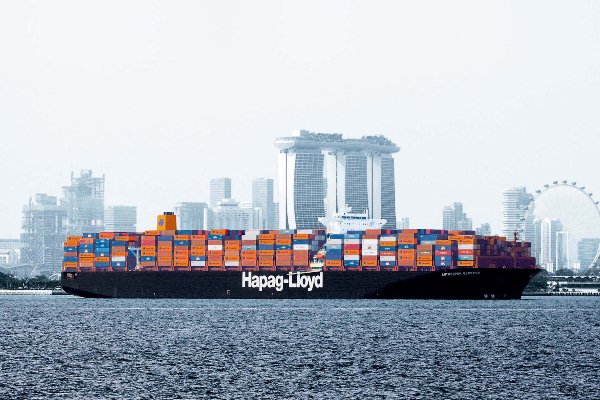
 Hamburg-based Hapag-Lloyd will retrofit a 15,000-TEU ship to operate using liquefied natural gas (LNG) in a pilot project that will pave the way for converting its large ships to LNG.
In future, the engine system of the vessel “Sajir” will be able to function using either of two types of fuel: LNG or low-sulfur fuel oil (LSFO), said the German ocean carrier in a release.
The contract for the retrofitting of “Sajir” was signed at the end of last week with Hudong HONDHOA Shipbuilding (Group) Co., LTD. The conversion will be carried out in the Shanghai-based shipyard Huarun Dadong Dockyard Co., Ltd.
While in the shipyard, the ship will have its fuel system and existing heavy fuel oil-burning engine converted into a dual-fuel engine. The plan will not just be to have the vessel operate using LNG, but to also make it able to use LSFO as a backup.
“By converting the ‘Sajir’, we will be the first shipping company in the world to retrofit a container ship of this size to LNG propulsion,” said Richard von Berlepsch, managing director of fleet management at Hapag-Lloyd.
“By carrying out this unprecedented pilot, we hope to learn for the future and to pave the way for large ships to be retrofitted to use this alternative fuel,” he added.
Using LNG in the shipping industry could potentially reduce CO2 emissions by 15% to 30% and sulfur dioxide and particulate matter by more than 90%.
The “Sajir” is one of the 17 vessels in Hapag-Lloyd’s fleet that were originally designed to be LNG-ready. Its 16 sister ships are also technically prepared for retrofitting. With the conversion of the “Sajir,” Hapag-Lloyd will be implementing a technological option to reduce the environmental impact of large vessels.
The International Maritime Organization (IMO) is set to implement a new lower 0.50% limit on sulfur in ships’ fuel oil from January 1, 2020.