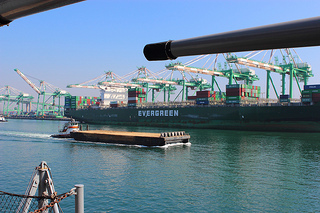
 MCC Transport, the intra-Asia arm of Danish shipping giant A.P. Moller-Maersk, still sees the Philippines as a potential transshipment hub in Asia, but notes some challenges standing in the way of realizing this.
“I agree Manila will not be able to compete with Singapore and (Tanjung) Pelepas and Port Klang as a mega hub, but I think it’s a mistake to think that transshipment is not interesting here,” MCC Transport chief executive officer Tim Wickmann said during a presentation at the recent 9th Philippine Ports and Shipping Conference.
MCC currently calls major Philippine ports including Batangas, Cagayan de Oro, Cebu, Davao, General Santos, Manila North Harbor, Manila South Harbor, and Subic.
Wickmann said the Philippines, situated just in the middle of Thailand, Japan, Indonesia and South Korea, and China, where many of the big flows in intra-Asia occur, means its location “is perfect for hub and spoke scenario.”
For instance, Wickmann said, cargoes sent from smaller ports in Eastern Indonesia usually move west to Singapore or Tanjung Pelepas first before heading east to ports in North China, but he says it’s also possible to move these shipments to Davao or to Manila on their way to China.
If Manila can succeed in attracting transshipment operations, “then there’s also so much more reason for shipping lines to have direct services between Manila and US West Coast,” he added. That would then change the entire picture, whereby products flowing from Indonesia and even from Thailand and Vietnam could connect in Manila.
Moreover, “you can combine (transshipments) with intra-Asia cargo… so you can also get scale,” Wickmann explained.
The shipping executive noted, however, that “the big issue” is that transhipping from China, Hong Kong, Taiwan, and other countries in Southeast Asia “is less than half the cost of doing transshipment in Philippines.”
He added that if the Philippines wants to pursue transhipping to gain maritime clout in Southeast Asia, it has to have “a totally different tariff for transshipment, like all the other ports are doing.”
“Only Japanese ports are more expensive than Philippine ports,” Wickmann noted, adding that with Manila’s average stevedoring rate having increased in the last five years, only Yokohama port’s rate is higher.
“And who in the end is paying for this? Because it’s not us. We cannot survive with this cost. It’s the customers. It’s the receivers of cargoes and it’s the exporters. They pay for this,” he added.
He said MCC is excited about proposed projects and development plans for the port industry in the Philippines, but added that costs play an important element.
“It’s not enough to have all these plans if it’s going to be very, very expensive to do because then the Philippine companies will lose competitiveness (to) all the other Asian companies trying to do the same things and develop the same things but at much cheaper cost,” Wickmann explained.
“And I think this is a discussion that needs to be taken here locally. I think it’s scary that Manila is only cheaper than Japan,” the shipping line executive said.
Aside from costs, the country must also improve port infrastructure and deepen drafts to accommodate larger vessels, acquire high capacity equipment and yard, and streamline customs involvement. – Roumina Pablo
Image courtesy of kongsky at FreeDigitalPhotos.net