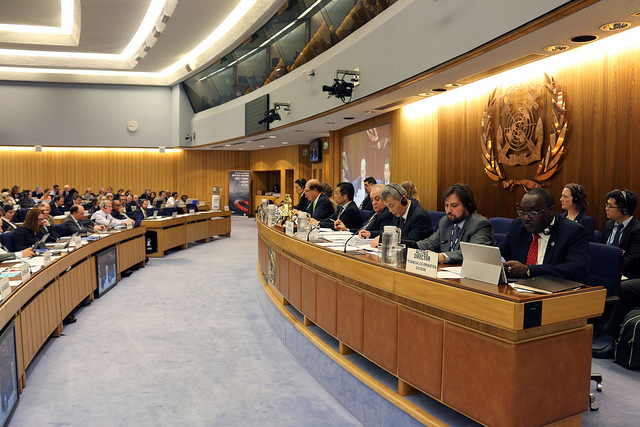
 The adoption of an initial strategy to reduce greenhouse gas (GHG) emissions from ships is one of the key items on the agenda of the International Maritime Organization’s (IMO) Marine Environment Protection Committee (MEPC 72), now holding its 72nd session from April 9 to April 13 at IMO Headquarters in London.
The initial strategy aims to develop a framework for all member states that is expected to set out the future vision for international shipping, the levels of ambition to reduce GHG emissions, and guiding principles.
The framework will include candidate short-, mid- and long-term further measures with possible timelines and their impacts on states, as well as identify barriers and supportive measures including capacity building, technical cooperation, and R&D.
In addition, the MEPC is expected to adopt draft amendments to regulation 21 of the International Convention for the Prevention of Pollution from Ships (MARPOL) Annex VI regarding Energy Efficiency Design Index (EEDI) requirements for ro-ro cargo and ro-ro passenger ships.
The energy-efficiency design standards for new ships and associated operational energy-efficiency measures for existing ships became mandatory in 2013 with the entry into force of relevant amendments to MARPOL Annex VI.
The committee will also address the implementation of the 0.50% sulfur limit.
From January 1, 2020, the limit for sulfur in fuel oil used on board ships operating outside designated emission control areas will be reduced to 0.50% m/m (mass by mass).
This will significantly reduce the amount of sulfur oxides emanating from ships and should have major health and environmental benefits, said IMO in a statement.
The committee is expected to approve draft amendments to prohibit the carriage of non-compliant fuel oil (except when ships are fitted with measures such as exhaust gas cleaning systems or “scrubbers”).
“IMO’s Sub-Committee on Pollution Prevention and Response (PPR) is currently developing guidelines to support the implementation of the 2020 sulphur limit,” said IMO.
“An intersessional working group will meet 9 to 13 July 2018. The MEPC will be asked to approve receiving draft guidelines on ship implementation planning for 2020 directly from the intersessional working group to MEPC 73 in October, in order to ensure appropriate guidelines can be considered by MEPC 73 and issued in good time.”
Also on the agenda is the implementation of the Ballast Water Management (BWM) Convention, which entered into force in September 2017 and which has, to date, been ratified by 69 countries, representing 75.11% of world merchant shipping tonnage.
The BWM Convention requires ships to manage their ballast water to prevent the spread of potentially harmful invasive aquatic species.
The committee is expected to adopt draft amendments to the BWM Convention that are to determine the implementation schedule for installations of ballast water management systems. This includes the schedule for ships to comply with the requirement to meet the so-called D-2 standard (draft amendments to section B).
Other draft amendments (to sections A and D) make mandatory the Code for approval of ballast water management systems, which will also be adopted at the session. Further draft amendments relate to section E on survey and certification.
With the BWM Convention’s entry into force, and the approval of a first set of amendments at MEPC 71, there is now increased emphasis on the convention’s effective implementation and enforcement, said IMO.
MEPC 72 is expected to finalize the associated data gathering and analysis plan that will allow a systematic and evidence-based review of the requirements of the convention and the development of a package of amendments to the convention as appropriate.
Photo courtesy of IMO