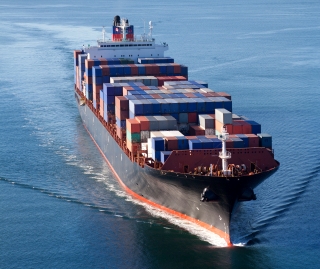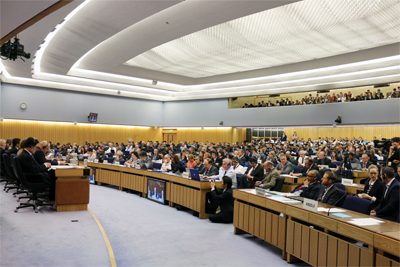

 More than 100 member states of the International Maritime Organization (IMO) adopted during the 72nd session of the IMO’s Marine Environment Protection Committee (MEPC) in London an initial strategy to reduce greenhouse gas (GHG) emissions from ships.
The initial GHG strategy sets out a vision to reduce GHG emissions from international shipping and phase them out as soon as possible in this century, the IMO said in a statement.
More specifically, under the identified “levels of ambition,” the initial strategy envisages for the first time a reduction in total GHG emissions from international shipping which, it says, should peak as soon as possible and to reduce the total annual GHG emissions by at least 50% by 2050 compared to 2008, while, at the same time, pursuing efforts towards phasing them out entirely.
The strategy includes a specific reference to “a pathway of CO2 emissions reduction consistent with the Paris Agreement temperature goals.”
The initial strategy represents a framework for member states, setting out the future vision for international shipping, and the levels of ambition to reduce GHG emissions and guiding principles.
It also includes candidate short-, mid- and long-term further measures with possible timelines and their impacts on states.
The strategy also identifies barriers and supportive measures including capacity building, technical cooperation, and research and development (R&D).
IMO Secretary-General Kitack Lim said the adoption of the strategy is another “successful illustration of the renowned IMO spirit of cooperation and would allow future IMO work on climate change to be rooted in a solid basis.”
According to the “Roadmap” approved by IMO member states in 2016, the initial strategy is due to be revised by 2023.
Continuing the momentum of work on this issue, the committee, which held the MEPC 72 session from April 9 to 13, agreed to hold the fourth intersessional meeting of the working group on reduction of GHG emissions from ships later in the year.
This working group will be tasked to develop a program of follow-up actions to the initial strategy, further considering how to progress reduction of GHG emissions from ships in order to advise the committee, and reporting to the next session of the MEPC (MEPC 73), which meets October 22-26, 2018.
IMO has already adopted global mandatory measures to address the reduction in GHG emissions from ships.
IMO is also executing global technical cooperation projects to support the capacity of states, particularly developing states, to implement and support energy efficiency in the shipping sector.
The initial strategy identifies levels of ambition for the international shipping sector, noting that technological innovation and the global introduction of alternative fuels and/or energy sources for international shipping will be integral to achieve the overall ambition.
The Paris Agreement on climate change was agreed in 2015 by Parties to the United Nations Framework Convention on Climate Change and entered into force in 2016.
The agreement’s central aim is to strengthen the global response to the threat of climate change by keeping a global temperature rise this century well below 2 degrees Celsius above pre-industrial levels and to pursue efforts to limit the temperature increase even further to 1.5 degrees Celsius.
The Paris Agreement does not include international shipping, but IMO, as the regulatory body for the industry, is committed to reducing greenhouse gas emissions from international shipping.
Photo courtesy of IMO