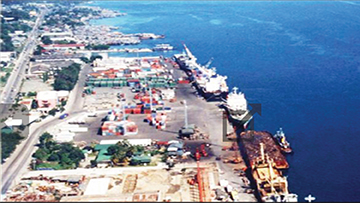

 The International Maritime Organization (IMO) is pushing ahead with measures aimed at reducing greenhouse gas (GHG) emissions from shipping, in line with the Paris Agreement and the United Nations 2030 Agenda for Sustainable Development.
IMO’s Marine Environment Protection Committee (MEPC) pushed forward with a number of measures to help achieve the objectives set out in the initial IMO strategy on reduction of GHG emissions from ships.
At the MEPC’s 74th session held May 13 to 17, the committee approved amendments to strengthen existing mandatory requirements for new ships to be more energy efficient; initiated the Fourth IMO GHG Study; adopted a resolution encouraging cooperation with ports to reduce emission from shipping; and approved a procedure for the impact assessment of new measures proposed.
To bolster existing mandatory requirements for new vessels to be more energy efficient, MEPC 74 approved amendments to MARPOL Annex VI that aim to significantly strengthen the “phase 3” requirements of the Energy Efficiency Design Index (EEDI).
The amendments bring forward the entry into effect date of phase 3 to 2022, from 2025, for several ship types, including gas carriers, general cargo ships and LNG carriers.
“This means that new ships built from that date must be significantly more energy efficient than the baseline,” said IMO in a statement.
For containerships, the EEDI reduction rate is enhanced significantly for larger ship sizes, as follows:
- For a containership of 200,000 DWT and above, the EEDI reduction rate is set at 50% from 2022
- For a containership of 120,000 DWT and above but less than 200,000 DWT, 45% from 2022
- For a containership of 80,000 DWT and above but less than 120,000 DWT, 40% from 2022
- For a containership of 40,000 DWT and above but less than 80,000 DWT, 35% from 2022
- For a containership of 15,000 DWT and above but less than 40,000 DWT, 30% from 2022
MEPC 74 also initiated the Fourth IMO GHG Study, which will include the following:
- Inventory of current global emissions of GHGs and relevant substances emitted from ships of 100 GT and above engaged in international voyages, including total annual GHG emission series from 2012 to 2018, or as far as statistical data are available.
- GHGs are defined as the six gases initially considered under the UNFCCC process: carbon dioxide (CO2), methane (CH4), nitrous oxide (N2O), hydrofluorocarbons (HFCs), perfluorocarbons (PFCs) and sulfur hexafluoride (SF6). The inventory should also include other relevant substances that may contribute to climate change, including Black Carbon (BC).
- Estimates of carbon intensity (estimates of world fleet’s CO2 emissions per transport work, from 2012 to 2018, or as far as statistical data are available).
- Possible estimates of carbon intensity of international shipping for the year 2008.
- Scenarios for future international shipping emissions 2018-2050.
“It is intended that the work could begin in Autumn 2019, with a view to the final report of the Study being submitted to MEPC 76, to be held in Autumn 2020,” said IMO.
At the same time, MEPC adopted a resolution encouraging voluntary cooperation between the port and shipping sectors of member states to contribute to reducing GHG emissions from ships.
This cooperation could include regulatory, technical, operational and economic actions, such as the provision of onshore power supply (preferably from renewable sources); safe and efficient bunkering of alternative low-carbon and zero-carbon fuels; incentives promoting sustainable low-carbon and zero-carbon shipping; and support for the optimization of port calls including facilitation of just-in-time arrival of ships.
The MEPC also approved a procedure for assessing impacts on states of candidate measures for reduction of GHG emissions from ships. Impact assessments should be evidence-based and should take into account analysis tools and models, such as cost-effectiveness analysis tools, e.g. maritime transport cost models, trade flows models, impact on gross domestic product; updated marginal abatement cost curves; and economic trade models, transport models and combined trade-transport models.
Also discussed were possible candidate short-, mid- and long-term measures aiming at reducing GHG emissions from ships, to be further considered at next sessions.
Candidate short-term measures for further consideration include concrete proposals to improve the operational energy efficiency of existing ships, speed and other technical and operational measures.
Concrete proposals on candidate mid- and long-term measures to be considered include measures aimed at encouraging the uptake of alternative low-carbon and zero-carbon fuels.
The International Chamber of Shipping (ICS) in a statement welcomed the important decisions made by the MEPC 74.
ICS Secretary General Guy Platten commented: “We welcome the adoption of important new IMO regulations to strengthen and bring forward the application of the Energy Efficiency Design Index for several different types of new build vessel, including containerships.”
He added that they hope to see further progress in developing more short-term measures to help the existing fleet reduce its emissions, and in IMO member states agreeing on some additional regulations during 2020 combining prescriptive and goal-based approaches that will deliver further GHG reductions before 2023.
Photo: Karl Brodowsky