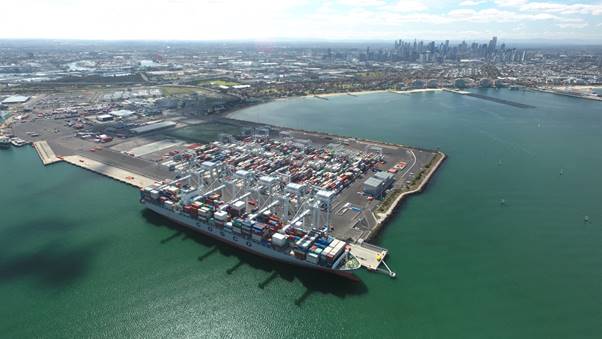

 Victoria International Container Terminal (VICT) in Melbourne is now the regular recipient of large container vessel calls, bringing the port into line with its peers on the east coast of Australia such as Sydney and Brisbane, port operator International Container Terminal Services, Inc. (ICTSI) said.
VICT, a subsidiary of ICTSI, started operations in 2017 and was developed as part of the Port of Melbourne’s Port Capacity Project (PCP), a Victorian State Government initiative conceived to redevelop Webb Dock East, to deliver the extra capacity needed to support Melbourne’s continued growth and to maintain the top position of busiest port in Australia.
In a statement, ICTSI said VICT’s leading-edge design and unique location on the bay side of the port means that for the first time shipping lines can access the Port of Melbourne without being restricted by the West Gate Bridge or the Yarra River Channel. This enables access for larger vessels of more than 8,000 twenty-foot equivalent unit (TEU) capacity, which the port operator noted are increasingly important to the future of the shipping industry and Australia’s economy.
Now complete is the first rotation of the A3C Central China-East Coast of Australia service comprising six vessels operated by ANL, COSCO, and OOCL featuring vessels with capacities in the range 8,063 to 8,500 TEUs, length overall from 320-335 meters and beams in the range 42.8 to 45.6 meters. This represents a significant step up from the 5,500 TEU capacity vessels that also operate in this trade lane.
VICT reports that the A3C vessels have arrived with a high utilisation — +85% – but with a <11m draught which means these vessel are serviced comfortably within the 14m water depth and there is no need for further dredging of Port Phillip Bay. It added that calls have been seamless with highly efficient berthing, handling and un-berthing with these particularly proven to be competitive with experience in Sydney.
VICT, developed at a cost of AU$660 million by ICTSI, is a fully automated terminal which in 2017 was the recipient of the Australia’s acclaimed Smart Infrastructure Project award.
“We are pleased to see VICT realising its potential and facilitating access to more economic shipping capacity to importers and exporters,” VICT chief executive officer Anders Dommestrup said.
“Larger vessels cascading into east coast Australia trades,” he adds, “is an established trend and the ability to service them is fundamental to the Port of Melbourne consolidating and expanding its position as a competitive gateway for international trade.”