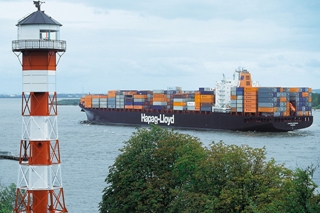
 Total capacity of container ships deployed on liner trades rose by 7.3 percent in 2011 to reach 15.9 million TEUs, according to a report by freight and logistics news service IFW.
About 97 percent of this capacity was contributed by cellular ships, IFW said, citing figures culled by industry analyst Alphaliner.
The cellular fleet expanded by 7.9 percent to 15.4 million TEUs, while non-cellular ships, such as multipurpose and con-ro (container-roro) vessels, saw total capacity cut by 9.5 percent.
The leading 20 shipping lines lorded it over the liner markets in combined capacity, which went up to 84.2 percent in 2011 from 83.1 percent in 2010. Their aggregate capacity grew by 8.7 percent over the year.
Danish shipping, logistics and energy conglomerate A.P. Moller-Maersk set the bar in capacity growth, according to a report by maritime news website gCaptain.com, also citing Alphaliner statistics.
In 2011, the shipping giant added 392,000 TEUs to its fleet, which includes Maersk Line, Safmarine, MCC-Transport, OACL and Seago Line, to increase its overall capacity by 18 percent. Over the past year, it further strengthened its bid for dominance by ordering 20 ultra-large vessels with individual capacities of 18,000 TEUs.
Geneva-based Mediterranean Shipping Company came in second, boosting its overall capacity by 250,000 TEUs more for a 14 percent increase. CMA CGM of France was third with an 11 percent capacity growth, and China’s COSCO was fourth with 19 percent.
Photo from Maersk Line