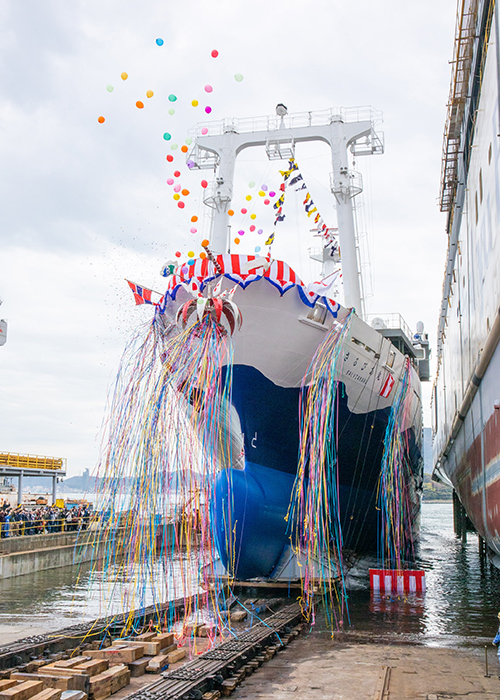
Mitsubishi Shipbuilding Co., Ltd, a member of Mitsubishi Heavy Industries, Ltd. (MHI) based in Yokohama, conducted on November 27 a christening and launch ceremony for a cargo-passenger ship currently under construction for Tokai Kisen Co., Ltd.
The new vessel will inherit the name Salvia Maru, replacing the second ship bearing the same name currently operated by the company. The handover is scheduled for June 2020 upon completion of rigging work, after which the vessel will enter service on a regular route connecting Tokyo with the Tokyo Islands of Oshima, Toshima, Niijima, Shikineshima, and Kouzushima, and will be used for the “Tokyo Bay Night Cruise” during the summer season.
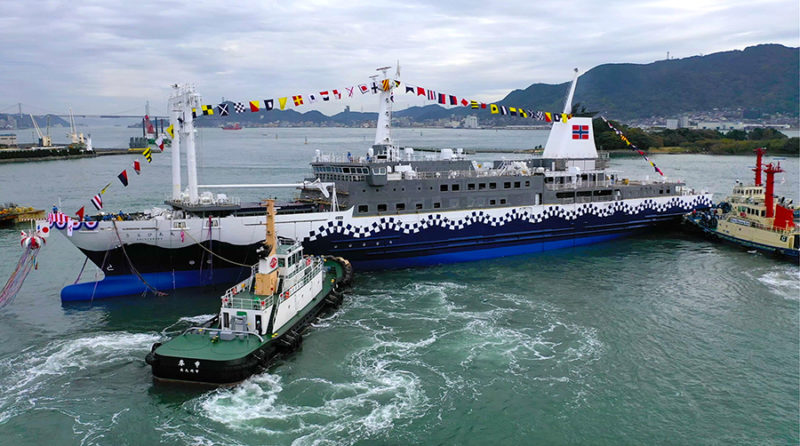
The launch was held at the Enoura Plant at MHI’s Shimonoseki Shipyard & Machinery Works in Yamaguchi Prefecture. The formal christening was conducted by Tokai Kisen President Junichi Yamazaki, with a ceremonial rope cutting by the fourth Tokai Kisen Mascot Girl, Natsumi Koike.
The new Salvia Maru is a joint construction project of the Yokohama-based Japan Railway Construction, Transport and Technology Agency (JRTT), an incorporated administrative agency to support the provision and maintenance of transport facilities and other infrastructure based on Japan’s transport policy. The vessel is jointly owned by JRTT and Tokai Kisen, built by Mitsubishi Shipbuilding in accordance with a three-party contract with Mitsubishi Shipbuilding, and will be operated by Tokai Kisen.
The new Salvia Maru is 118m long and 17m wide, with gross tonnage of approximately 6,200 tonnes. It has a prescribed capacity for 1,343 passengers and carrying capacity for 38 cargo containers, and is able to cruise at a speed of around 20 knots.
The propulsion system comprises variable pitch propellers and azimuth propellers with 360-degree horizontal rotation. As an eco-friendly ship, the Salvia Maru offers stable operation and improved energy efficiency, as well as a reduced environmental load and barrier-free accessibility.
Mitsubishi Shipbuilding will in the future continue to construct passenger ships, cargo carriers, and transport vessels that offer superlative fuel efficiency and environmental performance and contribute to stable transport.