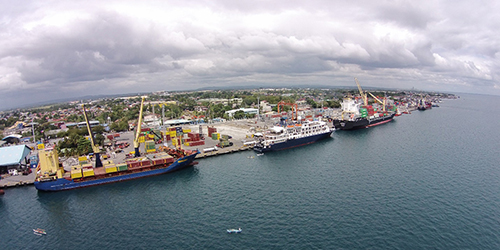
 Route traffic and ship calls at Philippine ports are among the details that may be viewed on a newly launched website developed by the public-private sector.
Open Transportation Portal was created jointly by the Department of Transportation and Communications (DOTC), Philippine Ports Authority (PPA), and Ateneo de Manila University (ADMU) as an online portal where stakeholders and the public can access data on activities at various ports in the country. This maritime database portal was developed as part of the Agri-Trade and Logistics Project, with the support of the World Bank Group – International Finance Corporation and the Government of Canada.
The portal, which recently went live, is part of the Open Data Initiatives of the Philippine government, a project that enlists the participation of different agencies and the public to make national data searchable, accessible, and useful.
The website (opentransport.ateneo.edu) aims to disseminate information from the PPA and Cebu Port Authority (CPA) on activities at various ports in the Philippines. PPA governs majority of the country’s ports while CPA has jurisdiction over Cebu maritime gateways.
Eventually, other port authorities such as the Subic Bay Metropolitan Authority, which oversees Subic port, and Phividec Industrial Authority, which has oversight over the Mindanao Container Terminal, may be asked to submit their data as well.
The online portal initially provides domestic traffic, which includes both volumes for cargo and passenger, as well as ship calls. Data are classified by port, by shipping line, and by connectivity. Ports and shipping lines are also ranked in terms of volume handled. Viewers can also check the flow of cargoes and passengers from one port to another.
The website notes, however, that information is provided as a public service by the DOTC and that accuracy or currency of data cannot be assured.
“Users should verify the information before acting on it. Although we make every effort to ensure that all information is accurate and complete, we cannot guarantee its accuracy or completeness,” it points out. This is because, historically, there have been problems in data transmission from the more than 100 or so ports that PPA manages.
This website will also feature datasets about air, rail, and road infrastructure projects from attached agencies of DOTC.
The datasets and tools, such as infographics and applications, were developed by the Pedestrian and Traffic Computing Laboratory of ADMU and other groups to make the information easy for viewers to understand.
According to a 2014 World Bank study entitled “Enhancing Competition Conditions and Competitiveness of Philippines Domestic Shipping Services,” information on vessel operations such as route traffic, cargo flows, and passenger services, is difficult to obtain in the country.
“The lack of market information often functions as a barrier to entry (of new domestic shipping lines) since incumbents have more information on market opportunities,” it said. – Roumina Pablo
Image courtesy of Goldy at FreeDigitalPhotos.net