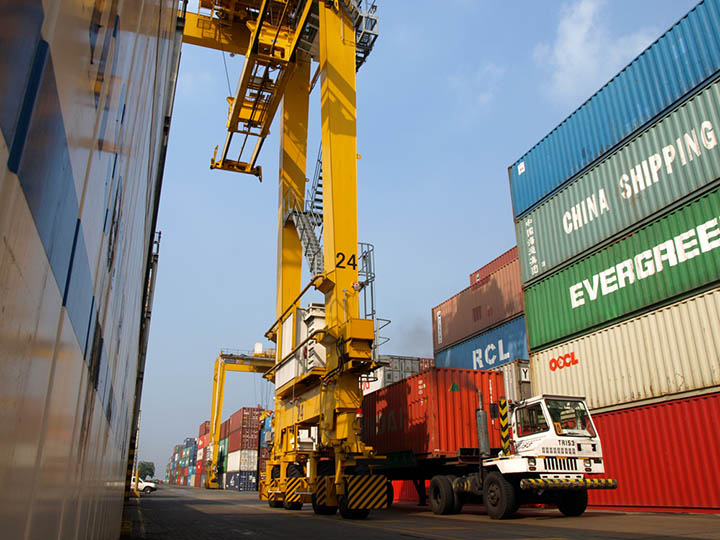
Despite the protracted Manila port congestion, the Semiconductor and Electronics Industries in the Philippines (SEIPI) upgraded its forecast for 2014 as global demand for electronic products continues to rise.
SEIPI said electronic exports will grow 7% to 11% this year, higher than its earlier estimate of 5% to 8%. For 2015, growth will be slower at 5% to 7%.
“We’ve come up with a revision the last quarter given the information and feedback from our members. We are upgrading to 7 to 11 percent for 2014. For 2015, we are looking at a 5 to 7 percent growth,” SEIPI president Dan Lachica said.
Lachica noted that these projections are within the range announced by the Department of Trade and Industry, and that “if we didn’t have port congestion, growth will be slightly higher than that.”
Arthur Tan, SEIPI chairman, said the whole industry is benefiting from a strong global demand, a trend expected to continue through next year and to be spurred by lower oil prices.
“Price of oil is down, the money supply of different economies is continuing…all governments of major economies are pushing for consumption, and consumption requirement is anchored on goods and services,” Tan said.
Wireless applications, smartphones, and automotive electronics will drive growth in the sector for this year and next, Tan added.
Electronic exports make up around two-fifths of the Philippines’ total outward shipments, growing 6% from January to October 2014 to US$20.9 billion from $19.8 billion in the same period last year.
Port congestion to affect growth prospects
However, Lachica noted that the port congestion may affect growth prospects, as some SEIPI members continue to face losses of about $20,000 up to $1 million per day of work stoppage due to lack of raw materials.
Lachica said no company has completely shut down operations, but some firms have started to shift their production elsewhere in the region.
Tan said the port congestion “will have an impact, more on an immediate basis.”
“Ports are used for certain types of materials like chemicals and bulk equipment. We’re not the only factory to produce the product, and if it will take us six months to come up with equipment as against the two months it will take to produce it in another country, then… (that may translate) to revenue losses for us,” Tan explained.
“Most of our members have already voiced their concerns that (the parent firms) are watching very closely how they will strategize expansion in the Philippines given limitations in the infrastructure and ports,” he added.
Lachica said they expect the port congestion problem to be resolved in the second quarter of 2015.
Image courtesy of nenovbrothers at FreeDigitalPhotos.net