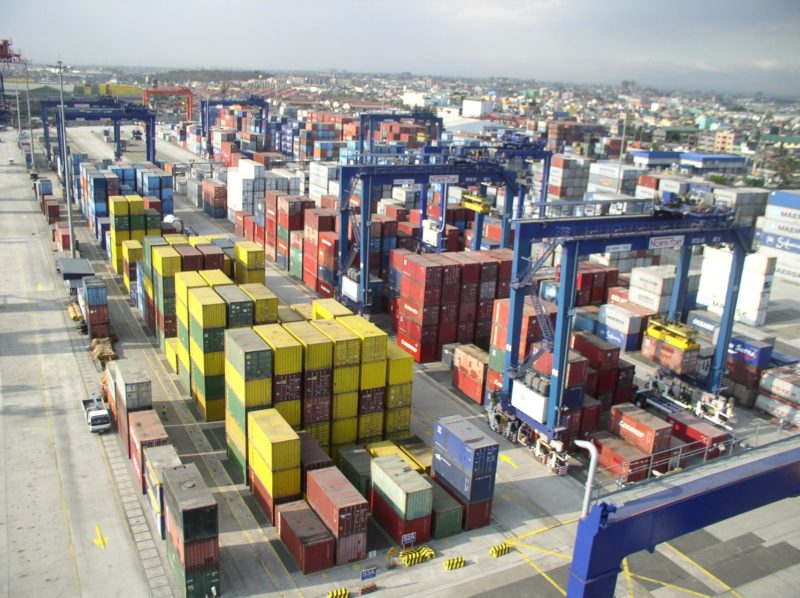

Cargo volume handled by Philippine ports registered a 2% increase in the first seven months of the year despite slow growth in local and foreign cargo traffic, according to the Philippine Ports Authority (PPA).
Latest data from PPA showed Philippine cargo volume reached 147.271 million metric tons (mmt) from January to July 2018 compared to the 144.412 mmt handled in the same period last year.
Foreign cargo throughput was at 87.639 mmt, 1.64% higher than the figure posted a year earlier. Of the total foreign cargo throughput, import volume handled was at 53.654 mmt while export traffic was at 33.985 mmt. Domestic volume, meanwhile, reached 59.631mmt, 2.48% higher than the volume processed in the same period in 2017.
PPA general manager Atty. Jay Daniel R. Santiago in a statement said cargo volume was a bit slow during the first seven months of the year, but that he remained upbeat about volume picking up towards the latter part of the year.
“Notwithstanding the decrease in the volume of export cargo by 0.98%, we were still able to post positive deviation in the overall cargo traffic,” Santiago said.
“Nonetheless, we are still on target of hitting our forecast of a modest cargo volume hike for 2018 of high single-digit to low double-digit growth,” he added.
Container traffic, on the other hand, increased 9% to 4.309 million twenty-foot equivalent units (TEUs) from 3.953 million TEUs last year due to a recorded uptick in domestic trade. Domestic boxes rose 10.37% to 1.755 million TEUs while foreign boxes registered an increase of 8.07% to 2.553 million TEUs. Imports contributed 1.290 million TEUs while export boxes chipped in 1.263 million TEUs, or an increase of 7.44% and 8.71%, respectively.
Passenger volume continues to expand, increasing 6.63% to 47.592 million passengers versus 44.631 million passengers in 2017.
PPA said the rise in passenger traffic was driven primarily by the continued reliance of the sea-traveling public on roll-on/roll-off vessels, fastcraft, and motorized bancas as primary modes of transportation for domestic inter-island travel. The increases were registered at the ports of Bohol, Mindoro, Negros Oriental/Siquijor, Bredco (Bacolod Real Estate Development Corporation)/Bacolod, and Surigao.
In addition, PPA said government efforts to promote cruise tourism likewise generated positive results as cruise passenger traffic recorded during the period totaled 229,388, or an increase of 216% against the first seven months of 2017. The increases were recorded at the ports of Surigao, South Harbor, Panay/Guimaras, Zamboanga, and Batangas.
Ship calls during the first seven months of the year also improved by 5.05% to 273,827 vessels from 260,669 vessels due to the increase in domestic ship calls by 5.33%.
Meanwhile, yard utilization at the country’s major gateways, which are the Manila ports of Manila International Container Terminal, Manila South Harbor, and Manila North Port, remained healthy with a combined utilization rate of 67%. Combined berth occupancy rate was likewise healthy, having an average of 59%, while quay crane productivity was at 24 moves an hour per crane.
“The silver lining in this situation is that our ports, particularly the Manila Ports, remain clog-free and ready to accept the influx of ‘holiday’ cargoes, which we expect to arrive in the next couple of weeks,” Santiago said.