
 A strong export sector pushed Philippine cargo throughput to 140.209 million metric tons (mmt) in the first three quarters of the year from 133.860 mmt year-on-year, reflecting a 4.74% rise.
Latest data from the Philippine Ports Authority (PPA) showed foreign cargo volume rose 8.82% to 85.347 mmt from 78.427 mmt. Import volume accounted for 41.629 mmt of the foreign volume, up 4.4% from last year’s 39.873 mmt. Export volume represented 43.717 mmt from 38.554 mmt or a 13.39% hike.
Domestic cargo volume, on the other hand, dipped 1.03% to 54.862 mmt from 55.432 mmt.
From January to September, container traffic grew 5.08% to 3.830 million twenty-foot equivalent units (TEUs) from 3.645 million TEUs in the same period last year.
Domestic containers reached 1.518 million TEUs , up 8.44% compared to 1.400 million TEUs in 2011.
Foreign boxes inched up 2.98% after throughput reached 2.311 million TEUs from 2.245 million TEUs. Import boxes increased 6.97% to 1.197 million TEUs from 1.119 million TEUs while export boxes declined 1% to 1.114 million TEUs from 1.125 million TEUs.
Substantial cargo throughput increases were posted in 17 port management offices with Puerto Princesa and Nasipit enjoying the biggest growth of 47.13% and 32.14%, respectively, according to PPA.
Volume declines were registered at the South Harbor (33.37%); Cotabato, (32.28%); Ormoc, (32.14%); and Iloilo, (9.21%).
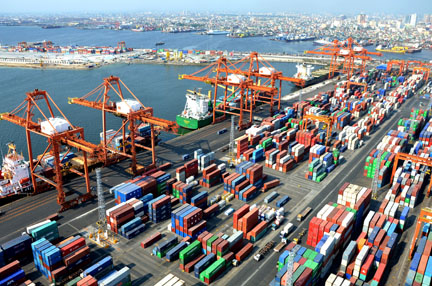
The Manila International Container Terminal, the country’s top international gateway, remained the top performer in terms of volume with a share of 10.6% followed by South Harbor at 7.2%.
Shipcalls for the first three quarters went up 2.06% from 256,434 to 261,722. Domestic shipcalls rose 2.3% while foreign shipcalls declined 5.3% as a result of consolidation moves by carriers where bigger but fewer vessels are deployed for economies of scale.
Passenger volume reached 37.94 million, up 1.53% compared to the same period last year. According to PPA, while there had been improvement in passenger volume, competition from budget airlines has been responsible for the continuing shift of domestic sea-based travelers to air transport.
Image courtesy of Manila International Container Terminal