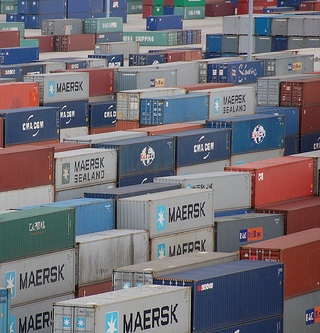
 THE Philippine government should shift development of ports and airports outside of Manila within three years to decongest Manila seaports and the Ninoy Aquino International Airport (NAIA).
In a recent letter addressed to economic managers of the Aquino administration, the Export Development Council, National Competitiveness Council, Philippine Chamber of Commerce and Industry, Joint Foreign Chambers, Supply Chain Management Association of the Philippines, Philippine Exporters Confederation, and the Management Association of the Philippines said cargoes should be diverted to the ports of Batangas and Subic from Manila and flights from NAIA to Diosdado Macapagal International Airport in Clarkfield, Pampanga, two hours from Manila.
“We recommend the issuance of a policy to shift foreign cargoes from the port of Manila to the newly developed international ports in Batangas (south of Manila) and Subic (north of Manila),” the groups said in the letter.
“It is recommended that all exports and imports going to and coming from South Luzon should be handled at the Batangas Port,” they said, adding that the Philippine Ports Authority and the Philippine Economic Zone Authority (PEZA) should issue separate memorandum circulars, with PPA directing international shipping lines through the Association of International Shipping Lines to service clients based/operating in South Luzon at the Port of Batangas, and PEZA directing its locators to load and unload their foreign cargoes also at Batangas.
The groups said Batangas port should be prioritized since there are enough cargoes from 1,000 locators in 42 industrial estates operating in the Cavite-Laguna-Batangas-Rizal-Quezon (Calabarzon) region.
According to PEZA data, of the 86% of export-import cargoes from PEZA-registered companies, 60% originate from the Calabarzon region.
Batangas port has an annual capacity of 400,000 twenty-foot equivalent units (TEUs) but traffic is only at 5,000 TEUs while Subic’s two new container terminals are capable of handling 600,000 TEUs each year but the actual traffic is only 21,623 TEUs.
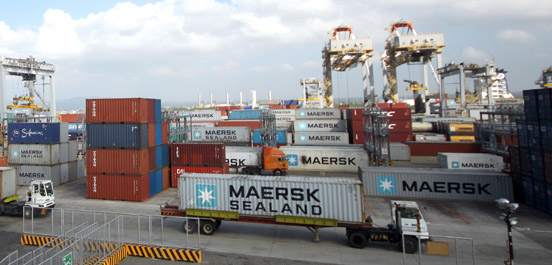
Manila ports, on the other hand, are now handling more than their capacity. The Manila International Container Terminal handles 1.611 million TEUs but has a capacity of only 1.5 million. At the South Harbor, traffic is at 988,268 TEUs each year while capacity is at 850,000 TEUs.
Photo by Jun Acullador